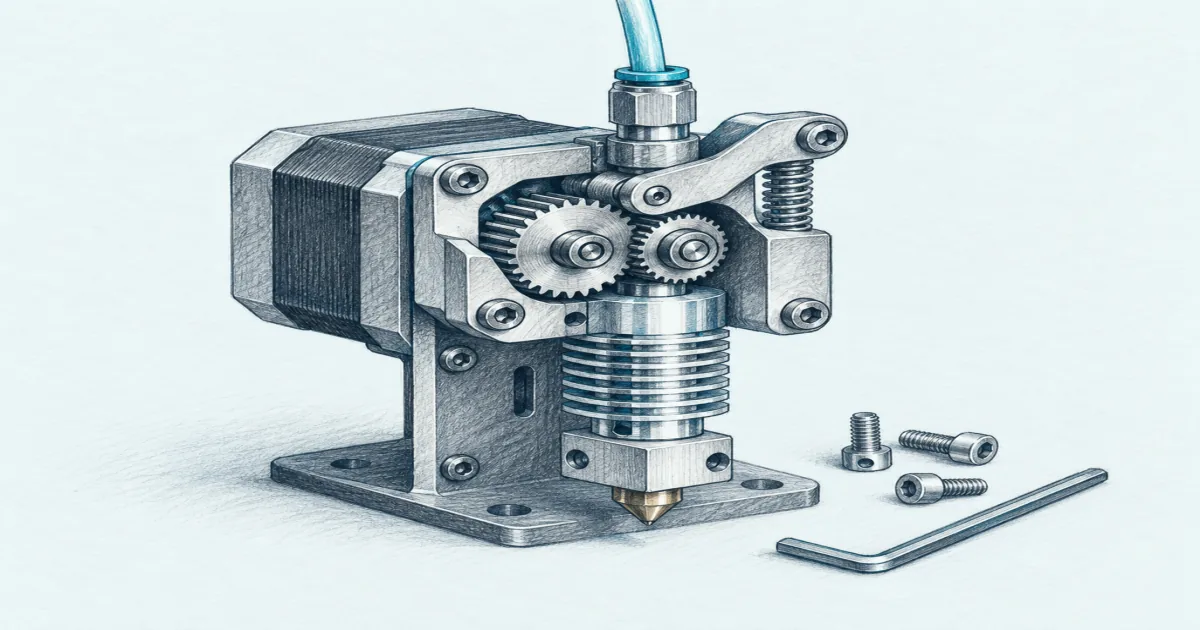
Direct Drive Extruder for 3D Printer (2026): Micro Swiss NG, Creality Kit, and When to Skip
Accessories
A direct drive extruder moves the feeder above the hot end so flexible filament and retraction actually work. The Micro Swiss NG is the cleanest drop-in for Creality CR-10 and Ender 3 frames. The official Creality kit is the budget answer when a $40 upgrade is the goal.
Our picks
A direct drive extruder moves the feeder stepper above the hot end. The filament only travels a short path between the drive gears and the melt zone. That short path is the whole point: flexible filament like TPU stops binding, retraction gets cleaner, and the print head becomes one compact unit instead of a long Bowden tube you have to tune around.
This guide ranks direct drive extruders for the most common home setup, the Creality CR-10 and Ender 3 family, and explains when a Bowden setup is still the right answer. Browse the wider bench upgrades in our accessory guides. For the matching nozzle work, see 3D printer nozzles. For the hot end that usually comes with these kits, see all metal hotend.
When direct drive actually helps
Direct drive is not a free upgrade. The added weight sits on the toolhead, which can reduce print speeds and increase ringing on tall parts. It also concentrates the heat creep risk near the motor.
You want direct drive when:
- You regularly print flexible filament like TPU, TPE, or soft PLA
- You run a Bowden printer like the Ender 3 and want tighter retraction
- You print engineering filaments that need precise extrusion control
- You want a compact, integrated print head on a custom build
Skip direct drive if you mostly print PLA on a Bowden setup that already prints cleanly. A well-tuned Ender 3 with Capricorn tubing and tuned retraction will handle PLA at 60 mm/s without the upgrade.
Do you need direct drive for PLA?
No. A clean Bowden Ender 3 prints PLA and PETG all day without the swap. Direct drive is worth it when flexible filament, tight retraction, or a compact print head is the problem you are actually trying to solve. Buy it for TPU; keep it if you later move to engineering filaments.
Top pick: Micro Swiss NG Direct Drive Extruder
The Micro Swiss NG Direct Drive Extruder for Creality CR-10 / Ender 3 is the cleanest drop-in on the market. It uses a 3:1 gear ratio with hardened steel dual-gear drive, an industry-short filament path of under 41 mm, and an integrated Micro Swiss all-metal hot end.
What that means in the room: flexible filament like TPU prints without binding, retraction works the same way as on a Bambu or Prusa, and the hot end handles temperatures up to 300 C for PETG, ASA, and nylon blends. The kit includes the adaptation plate, fan shroud, custom extension cable, and stepper motor. You bolt it in, calibrate E-steps, and print.
The one failure to plan for: heat creep
Heat creep is the failure behind most "my new direct drive clogs" posts, and it is fixable. The hotend fan has to run at 100 percent, retraction has to come down hard after a Bowden setup, and a little thermal paste between the hot end and the cooling block helps the heat break shed heat. Do those three and the clog stops.
Made in USA, Amazon's Choice, fits CR-10, CR-10S, CR-10-S5, CR-10-S4, Ender 3, Ender 3 Pro, and Ender 3 V2. For CR-10 V2, V3, and Neo series, Micro Swiss has dedicated NG variants, so check the listing before ordering.
Skip this if you only need a $40 official path. The Micro Swiss NG costs more than the official Creality kit, and you are paying for the design and build quality, not the brand name.
Budget V3 kit: Creality Ender-3 V3 KE Direct Drive Extruder Kit
The Creality Ender-3 V3 KE Direct Drive Extruder Kit is the budget answer for owners of the V3 family and the Ender 3 S1, Ender 5 S1, and Sermoon series. It ships with a dual-gear extruder, 3.5:1 gear ratio, and adjustable tension. You switch from Bowden to direct drive without modifying the existing mount.
It fits the Ender 3 V3 SE, Ender 3 V3 KE, Ender 3 S1, Ender 5 S1, Sermoon V2, CR-200B Pro, Sermoon V1, Sermoon V1 Pro, and Sermoon D3. For the original Ender 3, Ender 3 Pro, and Ender 3 V2, the Micro Swiss NG above is still the right pick.
What you give up compared to the Micro Swiss: the dual-gear geometry is a touch less refined, the cable harness is more fiddly, and the seller is a third-party Amazon store rather than Creality itself. For PLA and PETG on a V3-class printer, none of that matters. For daily TPU and engineering filaments, the Micro Swiss is still the better buy.
Premium official: Creality Sprite Extruder Pro Kit
The Creality Official Sprite Extruder Pro Kit is the OEM upgrade path if you want all-metal dual-gear feeding and a 300 C hot end without buying a third-party kit. It is the same extruder Creality ships on the Ender 3 S1 Pro and CR-10 Smart Pro.
Does the Sprite Pro clog like the old Sprite?
Much less often. The Pro's all-metal titanium heat break and aluminum heatsink run cooler than the plastic-body, PTFE-lined Sprite, so the soft-filament clog that plagued the original shows up far less. When a Pro does clog, the fix is usually heat-break contact, not a new nozzle.
The 3.5:1 gear ratio and 80 N extrusion force handle tougher filaments. The titanium heat break supports 300 C printing for nylon and polycarbonate blends. The mounting bracket covers Ender 3, Ender 3 Pro, Ender 3 Max, Ender 3 V2, and CR-10 Smart Pro out of the box.
This is the right pick when you want an OEM warranty and Creality support, and you do most of your printing with PETG or hotter filaments. It costs more than the standard Ender 3 kit but less than the Micro Swiss NG with hot end.
Prices and fit decide as much as the gear ratio, so here are the same three picks with the numbers that show up at checkout:
How to install a drop-in direct drive extruder
The three kits above are drop-in. The basic steps:
- Power off and unplug the printer. Wait for the hot end to cool.
- Remove the existing Bowden assembly and disconnect the stepper motor cable.
- Mount the new extruder to the supplied adaptation plate using the included screws.
- Connect the stepper motor cable to the existing motor port on the control board.
- Connect the new hot end heater and thermistor wires.
- Run a PID tune at your normal printing temperature.
- Calibrate E-steps in your slicer (most kits include recommended values).
- Print a calibration cube to verify extrusion and retraction.
You do not need to print brackets for any of these kits. The Micro Swiss and Creality kits include all mounting hardware. Plan on 30 to 60 minutes for the swap.
What changes in your slicer after the swap
Three settings move. E-steps change with the new gear ratio, so run the 100 mm extrusion test and set the value the kit recommends. Retraction distance drops sharply, often to under 1 mm, because the filament path is short. And a PID tune resets the hot end, since the new melt zone heats differently than the old one.
When Bowden is still the right answer
Direct drive is not always an upgrade. Bowden setups have real advantages:
- Lighter toolhead for higher print speeds and less ringing
- No heat creep risk from the stepper motor above the hot end
- Less expensive to maintain and easier to disassemble
If you mostly print PLA at 80 mm/s and never load TPU, your Bowden setup is fine. Save the upgrade money for better filament, a better plate, or an enclosure that lets you push to higher temperatures.
If you are buying a new printer today, Bambu Lab and Prusa printers ship with direct drive from the factory. The conversation only matters on Bowden platforms like the Ender 3 family.
Common mistakes when adding direct drive
Skipping the PID tune. The new hot end location changes the thermal response. Print at the wrong temperature for a week and you will get heat creep or under-extrusion. Run PID autotune before any real job.
Forgetting E-steps. The new extruder gears often have a different ratio than stock. Use the recommended E-steps from the kit documentation, or run the standard 100 mm extrusion test and adjust.
Using the wrong PTFE tube. Stock 4 mm Bowden tube does not fit a direct drive setup. Most kits include the correct Capricorn or short PTFE segment. Replace it if your kit did not.
Leaving the old Bowden cable bundle in place. That dead cable harness adds drag on the X carriage. Cut it out and remove the clip once the new extruder is mounted.
Pair the extruder with the right nozzle
Direct drive kits use MK8-thread nozzles on Ender 3 and CR-10. That is the same standard as the stock hot end, so your existing brass nozzles still fit. Add a hardened steel nozzle when you start printing carbon fiber, glow, or other abrasive filaments. Keep a silicone sock on the heater block to keep PETG strings off the new hot end.
For all-metal paths, also keep a silicone sock on the heater block. PETG strings collect on bare metal blocks and cause temperature fluctuations that show up as inconsistent extrusion.
Bottom line
The best direct drive extruder for a Creality CR-10 or Ender 3 is the Micro Swiss NG Direct Drive Extruder when fit, filament control, and hot end quality all matter. Pick the Creality Ender-3 V3 KE Direct Drive Extruder Kit for Ender 3 V3 SE, V3 KE, or S1 owners who want the lowest-price official-style drop-in. Step up to the Creality Sprite Extruder Pro Kit if you want OEM support and a 300 C hot end.
Browse the wider bench upgrades in our accessory guides. For the matching all-metal hot end, see all metal hotend. For flexible filament picks that benefit from direct drive, see best TPU filament.
Frequently Asked Questions
What is a direct drive extruder for a 3D printer?
A direct drive extruder mounts the feeder stepper motor directly above the hot end, so the filament only travels a short distance between the drive gears and the melt zone. This short path makes flexible filament like TPU and TPE much easier to print, and gives better retraction control on Bowden-style printers like the Creality Ender 3 series.
Do I need a direct drive extruder?
You need one if you regularly print flexible filament like TPU, or if you want tighter retraction on a Bowden printer. You can skip it if you mostly print PLA and PETG at moderate speeds. A well-tuned Bowden extruder still handles most everyday PLA prints without issue.
Which direct drive extruder is best for Ender 3?
The Micro Swiss NG Direct Drive Extruder is the cleanest drop-in for Ender 3, Ender 3 Pro, and Ender 3 V2. It uses a 3:1 gear ratio with hardened steel dual gears, ships with a Micro Swiss all-metal hot end, and fits without printed brackets or sandwiches. For Ender 3 V3 SE, V3 KE, and S1 owners, the Creality V3 KE kit covers the same job at a lower price.
Can I install a direct drive extruder without printing parts?
Most quality kits, including the Micro Swiss NG and the official Creality kit, are designed as drop-in replacements. They include the adaptation plate, fan shroud, and cable harness. You only need basic hand tools, not a 3D printer.
Does direct drive help with TPU and flexible filament?
Yes, that is the main reason to upgrade. The short filament path between the drive gears and the hot end keeps flexible filament under control. A Bowden setup has a long PTFE tube that flexes and binds when soft filament tries to push through, which is why TPU usually needs direct drive to print well.
Will a direct drive extruder fit a CR-10?
The Micro Swiss NG fits CR-10, CR-10S, CR-10-S5, CR-10-S4, and Ender 3 series. CR-10 V2 and CR-10 V3 need the specific NG variant for those frames. The Creality V3 KE kit covers Ender 3 V3 SE, V3 KE, S1, 5 S1, and Sermoon series.
How hard is it to install a direct drive extruder?
Plan on 30 to 60 minutes for most drop-in kits. You remove the existing Bowden assembly, mount the new extruder to the adaptation plate, reconnect the stepper motor cable, and recalibrate E-steps in your slicer. PID tuning is recommended after the swap. Most kits include written or video instructions.
Can I print carbon fiber with a direct drive extruder?
You can with the right nozzle. Direct drive does not change abrasive resistance. Add a hardened steel or ruby nozzle when you run carbon fiber, glass fiber, or glow-in-the-dark filament. The Micro Swiss NG uses an MK8 thread, so most aftermarket hardened nozzles fit.