3D Printer Enclosure (2026): Best Tents for Ender and Neptune
Accessories
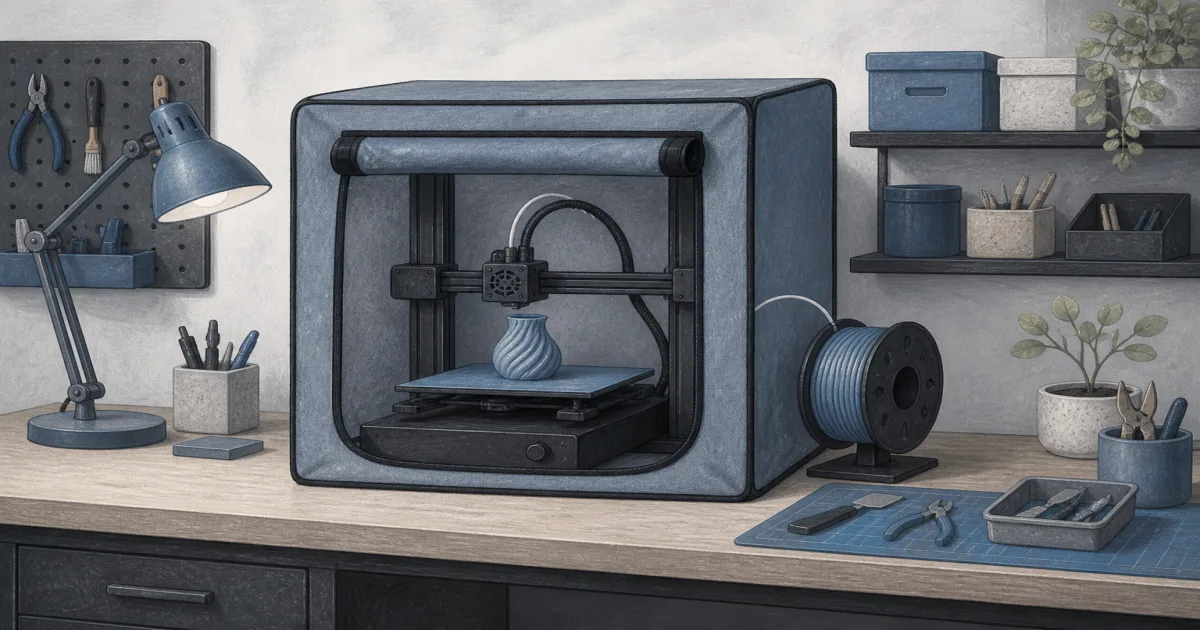
A 3D printer enclosure holds heat, blocks drafts, and cuts dust on open-frame machines. Creality covers most Ender desks. YOOPAI adds a vent and light. A large Oxford tent covers taller frames.
Our picks
A 3D printer enclosure is a box or tent that holds warm air around the frame. You want one when PETG corners lift, ABS cracks, or a ceiling vent blows across the bed. You do not need one to print a PLA hook on a calm desk. If the real problem is a wobbly table, start with a rigid 3D printer stand before you buy a tent. The full range lives in our 3D printer accessories.
If you already own an enclosed machine from best 3D printer or best enclosed 3D printer, skip the fabric tent. You already paid for walls.
Do you actually need an enclosure for your filament?
The answer is material-specific, and most people who land here already have a spool in mind. Match the tent to the plastic, not to a wish list.
PLA, PETG, and ABS inside a tent
PLA prints cooler and likes part cooling, so a sealed box can overheat the hotend and give you glossy, weak parts. Leave a panel unzipped. PETG likes still air and benefits from a tent in a cool room. ABS and ASA want the warmest box you can give them, plus dry filament and a brim on tall parts.
The table is the whole purchase decision. If your only spool is PLA, spend the money on dry storage instead.
How hot does a fabric tent actually get?
A tent heated only by the bed lands around 40 to 50 °C, which is exactly the ABS window. It is not a lab chamber, and it will not reach the 60 °C that some engineering plastics want.
What a fabric tent really reaches
The bed is the heater. A 100 to 110 °C plate under a cloth cover warms the trapped air to roughly 40 to 50 °C over time, which is enough for ABS and ASA corners to stay flat. A hard acrylic chamber holds that heat more evenly and seals harder, but it costs more and does not fold flat.
Where to route ABS exhaust
A tent holds heat and smell in equal measure. For ABS and ASA, add a vent path so fumes leave the room instead of sitting next to your chair. The YOOPAI bundles an exhaust port and a small fan, and a separate 3D printer air purifier covers a small room.
What size enclosure fits your printer?
Measure the printer with every add-on attached, because a tent that lists an Ender fit can still fail once a spool holder or dryer sits on top. Write the three numbers down before you order.
What to measure first
Tents list inner size, not "it will probably fit." Measure width, depth, and height with the spool holder on, then add a palm of space for your hand to reach the screen and the USB port. A top-mounted dryer steals height that a "fits Ender 3" claim does not account for.
Leave room for the zipper
A tight tent means fighting the zipper every time you swap a nozzle. The Creality tent's listed footprint is about 18.9 by 23.6 by 28.3 inches, and the YOOPAI envelope is 650 by 550 by 750 mm, which is roughly 25.6 by 21.7 by 29.5 inches. Both leave enough room for an Ender-class frame with the spool inside.
Which tent fits which job?
Best overall: Creality Official 3D Printer Enclosure
The Creality Official 3D Printer Enclosure Fireproof Tent is the default for most home Ender 3-class desks. It is a flame-retardant fabric tent on an iron-pipe frame, not a polycarbonate cabinet, and that is fine for home use. You get windows, tool pockets, and a cover that folds when guests need the table.
The tent holds enough heat that PETG corners stop lifting in a cool room once the zippers are closed. Assembly is pipe-and-sleeve work, not a weekend of carpentry. The cover is heavy textured nylon with a heat-reflective lining, which is why it also dulls fan noise and keeps dust off the sheet.
Skip it if you want a hard chamber with filtered exhaust built in. This is a warm box, not a lab hood. Expect to deburr the connectors and to fit the fabric loosely before you tension it.
Best with vent and LED: YOOPAI premium tent
The YOOPAI 3D Printer Enclosure with Ventilation Kit & LED is the upgrade when heat alone is not enough. The vent kit gives ABS and ASA fumes a path instead of trapping every smell next to your chair, and the LED strip makes first-layer checks less of a zipper workout. The bundled thermo-hygrometer is a bonus when you want a number rather than a guess about chamber feel.
Pay for this when you print engineering plastics often, or when the printer lives in a bedroom and odor routing matters. The live price is $59.99, against $69.99 on the brand store, so it is a reasonable upgrade over a basic heat-only tent. Skip it if you only print PLA.
Best for a large frame: VEVOR enclosure
The VEVOR 3D Printer Enclosure is the large-tent option. Its Oxford cloth cover fits frames that a printer-specific Ender tent cannot, which matters for taller gantries, wider beds, and add-ons like a top-mounted dryer. The viewing window and zipper door keep the workflow the same as any fabric tent.
Choose it when you want one tent that covers a big open frame without hunting for a listed brand fit. Functionally it does the same heat-and-dust job as Creality and YOOPAI. The difference is footprint and price.
Is a hard chamber better than a fabric tent?
A hard chamber holds heat more evenly and seals against room air. It also costs more, weighs more, and rarely folds flat. For most open-frame Ender and Neptune desks, a fabric tent plus a vent kit is the practical upgrade.
Skip the tent if your printer already has walls
A Bambu P1S, a Prusa XL, or a Qidi Q1 already ships enclosed, so a fabric tent on top is redundant. Save the tent for open-frame Ender-class and Neptune-class desks, or shop best enclosed 3D printer if you want the walls built in.
How do you set up an enclosure in one evening?
Assemble the frame over the printer, fit the cover loosely, then run one small part with the front closed enough to block the draft. You will know it is right when the first layer stops lifting and the screen, USB, and power switch stay reachable.
- Assemble the pipe frame on the floor, then stand it over the printer
- Zip three sides, leave the front open, and home the printer so nothing hits fabric
- Run a small PETG or PLA cube with the front closed enough to block the vent
- Check that the screen, USB, and power switch stay reachable
- Add the vent hose only after the frame is stable, and route exhaust toward a window or filter
If the frame wobbles, reseat the corner joints before you blame the printer.
What safety rules are not optional?
Keep a smoke detector in the room, do not park the tent against curtains, and do not leave a first print unattended overnight. The "fireproof" label means the cover is slower to spread flame. It does not mean you can ignore the printer.
Power bricks and heated beds still get hot. Give the power supply air, and do not bury cables under the floor of the tent.
Bottom line
A 3D printer enclosure is worth it when drafts and cool air wreck open-frame prints. The Creality Official 3D Printer Enclosure Fireproof Tent is the everyday tent for most Ender-class desks. Take the YOOPAI 3D Printer Enclosure with Ventilation Kit & LED when ABS odor and lighting matter. Choose the VEVOR large Oxford tent when the frame is taller or wider than an Ender. Measure the machine with every add-on attached, then zip up and print.
Frequently Asked Questions
Do I need a 3D printer enclosure for PLA?
Usually no. PLA likes cooling. Close the tent only if drafts ruin the first layer, or leave a panel unzipped so the part fan can do its job.
Will an enclosure make ABS print reliably?
It helps a lot by holding heat and blocking room air. It is not a magic chamber. Dry filament, a clean bed, and realistic part size still matter. See best ABS filament.
Is a tent safer than an open printer?
It cuts dust and keeps curious hands off moving parts. It does not replace a smoke detector, a clear floor, and unattended-print common sense.
Can I enclose a Bambu P1S or X1?
Those machines already have a hard enclosure. A fabric tent on top is redundant. Save the tent for open-frame Ender-class and Neptune-class desks, or shop best enclosed 3D printer if you want walls built in.
Will an enclosure make the printer quieter?
A little. Fabric tents dull fan noise. They will not turn a loud machine into a library printer.
Do I need a vent kit?
For PLA and PETG in a ventilated room, a basic tent is enough. For ABS or ASA, the YOOPAI vent kit is the smarter buy so fumes are not just trapped next to your desk. Pair longer ABS jobs with 3D printer air purifier habits if the room is small.
Can an enclosure help with PETG warping?
Yes for the corner-lift case under a draft or an AC vent. The tent holds still air around tall PETG prints. It will not fix wet PETG, a warped bed, or PETG that wants a brim. Dry the spool and level the bed before blaming room air.
Will a tent fit a spool holder on top?
Sometimes. Most tents list inner dimensions with no spool on top. Measure the printer with the spool arm or top-mounted dryer in place, then add a palm of space for the zipper. If the tent is tight, you will fight zippers every time you swap a nozzle.
Is a hard chamber better than a fabric tent?
Hard chambers hold heat more evenly and seal against room air. They cost more, weigh more, and rarely fold flat. For most open-frame Ender and Neptune desks, a fabric tent plus a vent kit is the practical upgrade. For Prusa XL, Bambu P1S, or Qidi Q1 enclosures, the machine already ships with walls and the tent is redundant.
Are 3D printer enclosures worth it?
They are worth it if drafts or cool room air wreck your prints, if you want to try ABS or ASA, or if dust keeps settling on the plate. They are not worth it for PLA on a calm desk, because PLA likes cooling. Match the purchase to a real problem, not to a wish list.
Do 3D printers need an enclosure?
Not by default. An open-frame printer prints PLA and PETG fine in a stable room. You need walls when the material needs warm still air, when the printer sits under an AC vent, or when you want less noise and dust in a shared space.
How much does it cost to build a 3D printer enclosure?
A DIY build with a Lack table, foam board, or a grow tent runs about $25 to $100 in materials, and it takes two to three hours. A fabric tent costs more but folds flat and holds resale value. If you enjoy building, the DIY route reaches higher chamber temperatures for ABS and ASA.
What is the best 3D printer enclosure for PLA?
For PLA, the cheapest tent is often the wrong buy, because a sealed box traps too much heat and can cause heat creep. If you only print PLA, fix the draft instead: a cardboard screen, a stable table, and a closed window usually cost nothing. A tent is for PETG, ABS, dust, and noise.