Best 3D Printer Nozzles (2026): Brass for PLA, Steel for Abrasives
Accessories
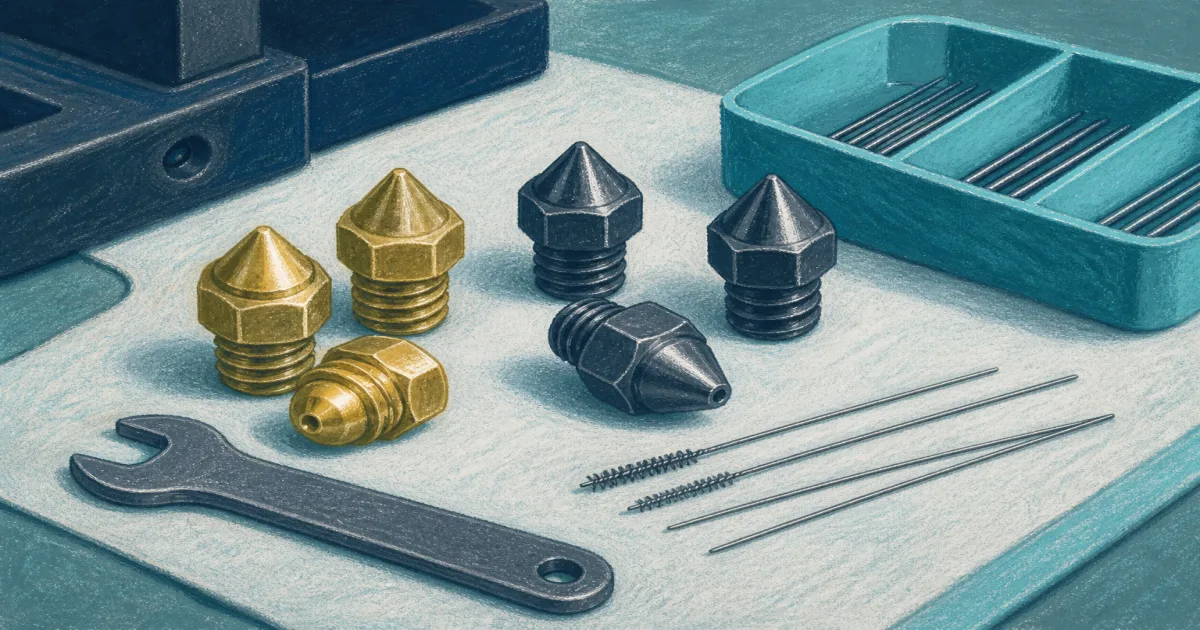
Most home printers want a fresh 0.4 mm brass nozzle. Switch to hardened tool steel when glow, wood, or carbon-filled filament starts wearing the brass tip. A size kit covers the rest of the bench.
Our picks
The best 3D printer nozzles for a home FDM desk are a fresh Creality Official 0.4mm Brass pack when you print PLA and PETG, plus Micro Swiss hardened steel when glow, wood, or carbon mixes start wearing the hole. A multi-size brass kit is the third buy once 0.4 mm already works.
3D printer nozzles are the cheap part people ignore until prints go fuzzy. The hole wears. The first layer looks drunk. Then someone blames the slicer. A five-dollar brass pack fixes more “mystery” quality drops than a new printer.
Browse tips and bench gear in our accessory guides. If drafts or ABS heat are the bigger desk problem, start from the 3D printer enclosure pillar. For the wrench and needles, see 3D printer tools kit.
Quick comparison
Match the thread to your hotend before you order. If heat creep or PTFE liner wear is the real limit, read the all metal hotend upgrade guide before you keep swapping tips.
Daily brass: Creality 0.4 mm
Creality Official 0.4mm Brass Nozzles are the spare pack we want on an Ender 3 or CR-10 desk. Five tips, all 0.4 mm, OEM brass. Swap the worn one. Keep the rest sealed.
Stock 0.4 mm is the default for a reason. It prints the models in best 3D printer filament without turning every job into a slow miniature or a chunky brick. Replace the worn one. Keep the rest sealed.
Skip this pack if your hotend is not MK8 / M6. Bambu, some Sprite upgrades, and volcano clones use different tips. Check the thread before you click.
Abrasive upgrade: Micro Swiss steel
The Micro Swiss MK8 Hardened Steel Nozzle is the 0.4 mm tool-steel upgrade for the same MK8 family. It is the pick when you print filled filament that would chew brass.
Install it when you commit to glow-in-the-dark, wood, or carbon PLA. Do not wait until brass has already opened up. After the swap, re-level or reset Z-offset. The new tip may sit a hair differently.
If you only print Hatchbox PLA, you do not need this yet. Buy brass spares first.
Size kit: Creality 24-piece brass
The Creality Official MK8 Brass Nozzle Kit packs 0.2 mm through 1.0 mm brass tips with plenty of spare 0.4 mm. Use it after daily 0.4 mm prints already look good and you want controlled experiments, not a junk drawer of mystery tips.
Change line width in the slicer to match the new hole. A 0.8 mm nozzle with a leftover 0.4 mm profile is a confused print. Stay on 0.4 mm until you have a reason. Beginners in best 3D printer for beginners should not start the hobby on a 0.2 mm tip.
Which nozzle material should you use for which filament?
Use brass for PLA and PETG, and hardened steel for anything abrasive. Glow, wood, carbon, glass, and metal-filled filaments wear a brass hole wider and oval. Plain PLA never justifies steel.
Brass heats better, steel lasts longer
Brass heats evenly and is easy to machine, which is why stock printers ship with it. It also wears. Abrasive particles turn a round 0.4 mm hole into a wider, oval mess, and your extrusion multiplier then looks wrong even though the slicer did not change.
Hardened steel lasts through those mixes and can need a slightly higher temperature. It is not automatically better for PLA figurines. Use steel when the filament is the problem, not because it sounds tougher. For a dedicated abrasive buy guide, see best hardened steel nozzle. For a brass-only PLA and PETG buy guide, see best brass nozzle.
How often should you replace a brass nozzle?
Replace a brass 0.4 mm tip when first-layer lines look wider, underextrusion survives a clean, or you have run a spool of glow, wood, or carbon filament. Many people swap every few months of daily PLA.
What a nozzle really costs per spool
A single 1 kg spool of glow or carbon filament can open a brass hole in weeks, so one $20 steel tip is cheap against a drawer of worn brass. For everyday PLA, the 24-piece kit works out to about $0.54 a tip, and 12 of those are 0.4 mm, which is the size you actually wear out.
How to swap a nozzle without wrecking the heater
Heat the hotend to printing temperature so the old tip breaks free with less force. Hold the heater block with the right wrench so you do not twist the wires. Swap quickly, snug the new nozzle against the tube or heat break per your hotend’s instructions, then let it cool and check for leaks on a small cube.
Heat the block, hold the heater, swap fast
The two ways people wreck a heater are twisting the block and over-tightening cold. Heat first, hold the block with a second wrench, and only snug the new tip. If plastic weeps from the threads, it is not tight enough or the tube is not seated. Do not keep printing “just to see.” That is how you buy a new heater block.
Signs your current nozzle is done
Watch for these:
- First-layer lines look wider than they used to, with the same Z-offset
- Underextrusion survives a careful clean
- Fine details go mushy after months of daily PLA
- You printed abrasive filament and quality fell the next week
- A cold pull comes out clean, but underextrusion remains
If a needle and a temperature bump do not help, replace the tip. Nozzles are cheaper than another weekend of slicer experiments.
After the swap: one cube, then real parts
Do not jump straight into a six-hour print. Run a small cube or a first-layer square. Watch the skirt. If plastic weeps from the threads, stop and reseat. If the first layer is too high or too low, reset Z-offset. A new tip can sit a fraction differently than the worn one you just removed.
Write the date and size on a bit of tape on the spare bag. You will forget which brass 0.4 mm is the fresh one.
Will these nozzles fit your printer?
These three picks assume an M6 MK8-style hotend, which covers a lot of Ender 3 and CR-10 desks. They do not cover Bambu A1, P1S, or X1 hotends, and they do not cover volcano clones with a longer thread.
Match the thread before you order
MK8 tips have a short body of about 13 mm, so they will not seat in newer long-nozzle hotends such as the Ender 3 V3 KE. If the listing photo does not match the metal in your hand, do not force it. A wrong thread wrecks the block. Keep one known-good brass 0.4 mm in a labeled bag as a rollback, so when a new steel tip acts weird you have a five-minute path back to yesterday’s settings.
Bottom line
Stock Creality Official 0.4mm Brass Nozzles for everyday PLA and PETG on MK8 hotends. Move to the Micro Swiss MK8 Hardened Steel Nozzle when filled filament is on the menu. Add the Creality Official MK8 Brass Nozzle Kit when you want smaller and larger brass sizes without guessing Amazon mystery packs. Match the thread, heat the block, and replace worn brass before you rewrite every setting.
Frequently Asked Questions
What size 3D printer nozzle should I use?
Start with 0.4 mm. It balances detail and speed for most home parts. Drop to 0.2 mm only for tiny text. Jump to 0.6 mm or 0.8 mm for fast, chunky prints.
What is the best nozzle for PLA?
Fresh 0.4 mm brass is the best nozzle for PLA on most MK8 hotends. Hardened steel is optional for PLA unless you are also running abrasive blends.
How often should I replace a brass nozzle?
When first-layer lines look wider, underextrusion shows up after a clean cold pull, or you have printed glow or wood filament. Many people swap every few months of daily PLA.
Do hardened nozzles need a higher temperature?
Often 5 to 10 C higher than brass for the same filament. Steel conducts heat a bit differently. Run a small cube after the swap.
Will these nozzles fit a Bambu A1 or P1S?
No. Those machines use a different hotend family. Buy the official Bambu nozzle for that platform. These MK8 picks are for Ender, CR-10, and similar M6 tips.
Can I clean a nozzle instead of replacing it?
Needles and a cold pull help with a clog. They do not fix a worn orifice. Once the hole is oval, buy a new tip. See how to unclog a 3D printer nozzle.
Should I use a silicone sock with a new nozzle?
Yes on compatible MK8 blocks. A sock keeps plastic off the heater while you print. Keep a spare cover in the same drawer as your tips. See silicone socks for 3D printers.
Do I need a different nozzle for every filament color?
No. You need a clean tip and a purge when switching light colors after dark ones. Material type matters more than color for brass versus steel.