Best CNC Milling Machine for Home Makers (2026): 3 Desktop Picks
Accessories
A desktop CNC lets you cut flat stock and simple parts instead of printing them. These three machines cover a $339 starter, a $499 all-rounder, and a bigger 600mm bed.
Our picks
A desktop CNC milling machine cuts flat stock instead of printing it. That is the appeal for a home maker. You can turn a sheet of plywood into a sign, a block of acrylic into a faceplate, or a thin aluminum plate into a bracket, and you can do it with a rigid frame and a spinning bit rather than a hot end.
The best CNC milling machine for most home shops is the Genmitsu 4040-PRO, because it balances a usable bed size against a price that still makes sense for a garage. If your bench is still coming together, the rest of our accessories guides cover the supporting tools, and the enclosure pillar is worth reading if dust is your main worry.
Before you buy, be clear about what you want. A CNC engraves flat stock and cuts shapes. A laser engraves and cuts thin material too, and our best laser engraver for beginners guide covers that lane. If your projects are rounded, dimensional, and textured, you probably want a 3D printer rather than either.
What a home CNC milling machine is for
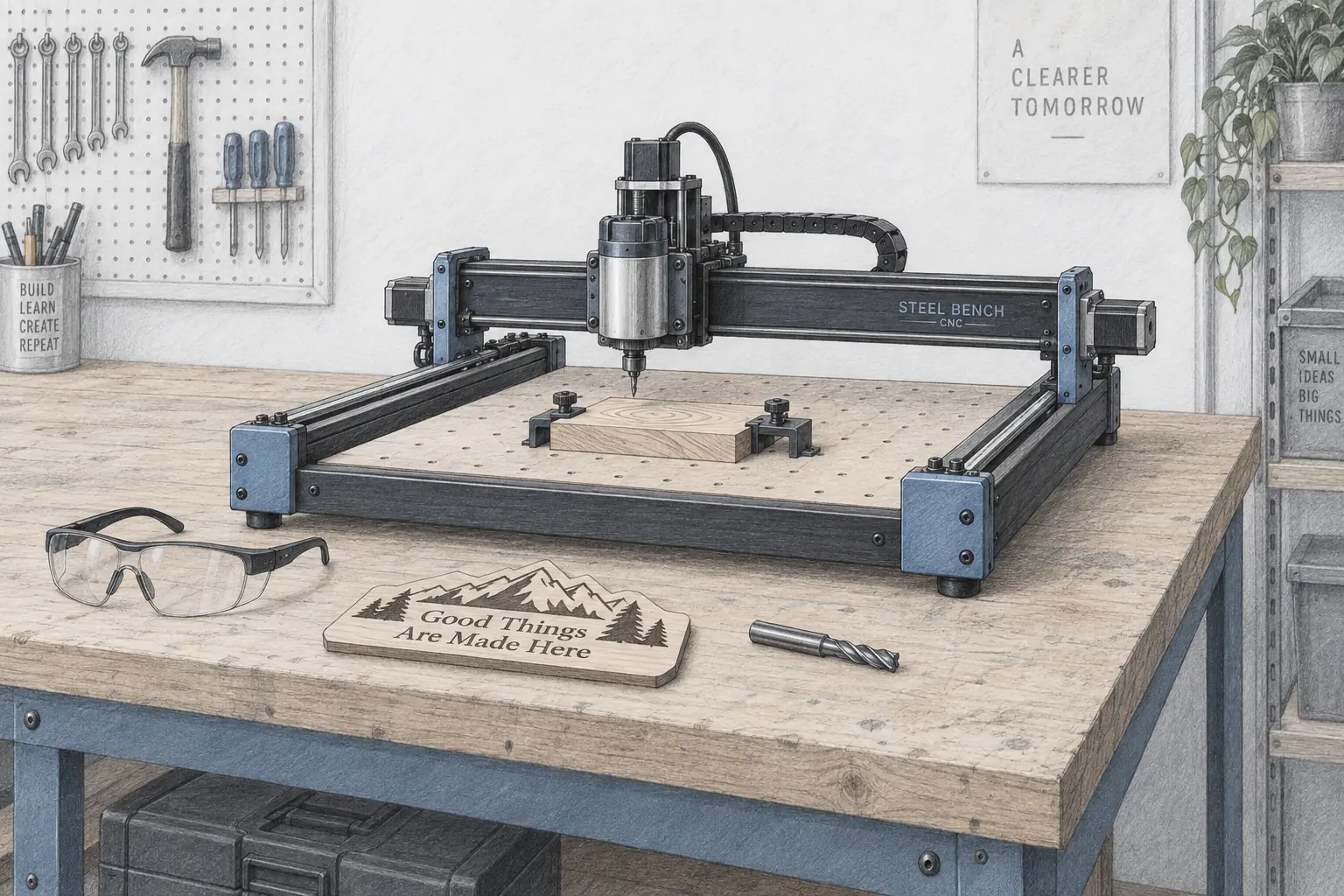
These are small gantry routers. A bed holds the stock, a gantry moves a spindle in three axes, and a controller reads G-code to follow a path. On a budget machine, the useful work is signs, relief carvings, jigs, faceplates, and light cuts in soft metal. They are not lathes and they are not production mills.
Three specs decide how much you will enjoy one. Work area sets the biggest project you can clamp. Spindle power sets how fast the bit can bite without stalling. Frame rigidity sets whether the cut stays at the depth you asked for. A bigger bed with a flexing frame is worse than a smaller one that holds still.
Desktop CNC picks at a glance
Best overall: Genmitsu 4040-PRO
The Genmitsu 4040-PRO is the pick for most home shops. It gives you a 435 x 400 x 80 mm working area, dual 16mm steel tubes on each axis, lead-screw drives, and a silicon-carbide-style reinforced spoilboard with a centre aluminum support bar. That last part matters more than it sounds. A flat bed is what keeps a varnished sign even from edge to edge.
The controller is a 32-bit board with silent drivers, and it runs GRBL, so Candle, Universal Gcode Sender, and the usual CAM tools all work. Assembly is modular, with a quoted fifteen-minute build. The machine also scales, and long-term owners treat the spindle kit as the first real upgrade once the stock motor feels slow.
The honest limit is spindle torque. This class of machine cuts 1/8 inch bits through wood, acrylic, and MDF all day, and it engraves light aluminum, but it is not a metal mill. Owners describe it as a stepping stone for small projects with small bits, and that is exactly right.
Choose the 4040-PRO if you want one machine that covers signs, carvings, and small parts. Skip it if most of your work is metal, because you need more rigidity than any machine in this price band offers.
Best budget starter: LUNYEE 3018 PRO MAX
The LUNYEE 3018 PRO MAX is the cheapest sensible way in. It has a 300 x 180 x 80 mm working area, a 500W spindle that runs up to 12,000 rpm, six limit switches, and an emergency stop. For a first machine, the offline controller is the feature that stands out, because it lets you test motion without a computer and confirms the machine is alive before you blame your G-code.
The all-metal frame uses reinforced aluminum profiles and 12mm optical axes, and the Z travel is deeper than a typical 3018, which matters if you want to carve into thicker stock. The 1.8 inch offline display shows coordinates, so it can run a job from an SD card on its own.
The tradeoff is the bed. At about 300 x 180 mm you are doing trim pieces, engraving, and small plates rather than half a sheet of plywood. The stock cutters also leave burrs on aluminum, and the kit benefits from a better USB cable. Neither is a dealbreaker at this price, and the model currently carries a live discount, which makes it a good time to try CNC without a big outlay.
Choose the LUNYEE if you want to learn the workflow cheaply and mostly cut small parts. Skip it if your first project is a large sign.
Best for bigger jobs: FoxAlien Masuter Pro MAX
The FoxAlien Masuter Pro MAX is the step up for work that outgrows a small bed. It offers a 600 x 600 mm work area with 100mm of Z pass height, a 500W brushless spindle built for continuous cutting, and a strengthened X-axis extrusion that reduces vibration at higher feed rates. The control board is designed to accept closed-loop steppers later, so the machine can grow with you.
That combination suits panels, large signs, and repeat work. The brushless spindle is the real difference from a budget router, because it runs quieter, cooler, and longer, which matters on a job measured in hours rather than minutes.
The honest caveat is the drive system. Belts are fast and cheap to maintain, but they stretch, and owner threads about the Masuter line describe a sudden shift mid-cut that traces back to belt tension or a dry rail. Add a tension and lube check to your routine and it stays accurate. Ignore it and you will scrap a part.
Choose the Masuter Pro MAX if you need a big bed and long sessions. Skip it if your projects fit on a 400mm machine, because you would be paying for area you do not use.
Software and setup for a first cut
Plan on two learning curves, not one. The machine is the easy half. CAM is where the evenings go.
Start with a simple design and a known toolpath. A nameplate or a coaster with a shallow pocket teaches you work zero, feed rate, and depth per pass without risking much material. Save the intricate relief until the basics are boring.
Workholding decides whether parts come out or fly across the shop. Double-sided tape and thin superglue hold small parts well on a spoilboard, and clamps handle bigger stock. Keep a spare spoilboard so a mistake costs a board instead of a machine.
Keep the machine clean. Dust from MDF and wood packs into a lead screw and turns into grit. Brush the rails after each session, and add a dust shoe once you are cutting regularly. If the machine lives indoors, the same airflow advice from our enclosure pillar applies to dust as much as fumes.
What these machines will and will not cut
The pattern is simple. Soft sheet goods are the point of these machines, and metal is a bonus within tight limits. A heavier spindle helps, but rigidity is what actually decides whether aluminum works.
When a CNC is the wrong buy
Skip a CNC if your projects are rounded, textured, or organic. A router makes flat parts and shallow reliefs. A 3D printer makes the dimensional shapes, and a laser handles flat surface work faster. Buying the wrong tool is how people decide a whole category is frustrating.
Skip it if you cannot spend the time on CAM. The machine will cut what you tell it to cut, including into its own bed if the zero is wrong. Budget a few evenings before your first useful part.
Skip the big machine if you are not sure yet. A 3018 is cheap enough to learn on, and the workflow transfers directly to a larger frame later. Buy area only when you have a project that needs it.
Bottom line
The Genmitsu 4040-PRO is the best CNC milling machine for most home makers, with a 400mm bed, steel-tube motion, and a reinforced spoilboard that holds depth across a wide cut. The LUNYEE 3018 PRO MAX is the cheapest way to learn the workflow, with an offline controller that proves the machine before you write a line of G-code.
The FoxAlien Masuter Pro MAX is the pick when you need a 600mm bed and a spindle that runs for hours. Buy the one that matches your first real project, keep the cutters small, and learn CAM before you buy a bigger frame.
Frequently Asked Questions
What is a CNC milling machine?
A CNC milling machine is a computer-controlled cutting tool that moves a spinning bit through wood, plastic, or soft metal along a programmed path. On a desktop scale it looks like a small gantry router with a bed, and it takes a design file and turns it into a cut part. The "CNC" just means the motion is driven by G-code rather than by hand.
What is the best CNC mill for beginners?
The LUNYEE 3018 PRO MAX is the easiest place to start because it ships mostly assembled, has an offline controller for testing the axes, and costs the least here. If you already know you want a 400mm bed, the Genmitsu 4040-PRO is the better long-term buy for a little more.
How much do CNC machines cost?
A desktop hobby machine runs about $200 to $1,000. The budget end, around $200 to $350, buys a 3018-class router with a small bed and modest spindle. Around $500 gets a rigid 400mm machine like the Genmitsu. Above $800 you are buying work area and a spindle that can run for hours.
Can a desktop CNC cut aluminum?
Yes, carefully. These machines cut thin aluminum sheet and small brackets with shallow passes, a single-flute cutter, and conservative feed rates. They are not built for heavy stock removal. If aluminum is most of your work, plan on light cuts, good clamping, and accepting that each part takes a while.
Do I need a 3D printer to own a CNC?
No, they are separate tools with separate skills. They do pair well, though. A printed dust shoe, a printed clamp, or a printed fixture is often the fastest way to solve a workholding problem. Both live in our accessories guides.
What software do desktop CNCs use?
Most run GRBL firmware, which talks to Candle, Universal Gcode Sender, Easel, or Fusion 360. You design the part in CAD or a sign-making tool, generate G-code from a CAM step, then send it. The machine side is the easy half. Learning CAM is where the first week goes.
Is a CNC router the same as a milling machine?
They overlap. A router spins a bit at high speed for wood and sheet goods, while a milling machine turns a cutter more slowly with more rigidity for metal. Desktop hobby machines are usually routers that can mill soft metal if you keep the cuts light.