Best Heat Gun for 3D Printing (2026): Stringing, Inserts, and Smoothing
Accessories
A heat gun fixes the small stuff on a print: stringing, stubborn supports, and heat-set inserts. A variable-temperature full-size unit covers the bench, and a 380W mini reaches the tight spots.
Our picks
The best heat gun for 3D printing is one with a dial, not a two-position switch. Most printed plastic work happens between the extremes, and the SEEKONE 1800W Variable Temp is the tool that lets you sit there. Turn it down, sweep it past a stringy surface, and the strings pull in without touching the part.
A heat gun is the least glamorous tool on the bench and one of the most used. It softens a support stump so it lifts without tearing, shrinks the stringing that shows up on a humid day, seats threaded inserts, and eases a warped brim back flat. It lives with the rest of your 3D printer accessories, and if you work with ABS or ASA, it belongs in the same corner as your 3D printer enclosure and your 3D printer fire safety setup.
Start with the best sandpaper for 3D prints and the best filler primer for 3D prints when a surface needs real work. Heat is for the jobs sanding cannot do.
What a heat gun actually fixes on a printed part
Four jobs cover almost everything.
- Stringing. Thin wisps between towers disappear when you pass heat over them. The plastic pulls back instead of smearing.
- Support removal. Heat softens the interface layer so a stubborn support breaks off cleanly instead of taking surface with it.
- Heat-set inserts. Warm brass into a printed boss and it seats flush with clean threads, which beats a screw biting raw plastic.
- Shine and cleanup. A quick pass takes the dusty white blush off a sanded surface and evens out light marks before priming.
It is also the tool people abuse the most. The two ways to wreck a print are holding the nozzle still and running full power on a thin wall. Both are avoidable with a dial and a little patience.
Top pick: SEEKONE 1800W Variable Temp Heat Gun
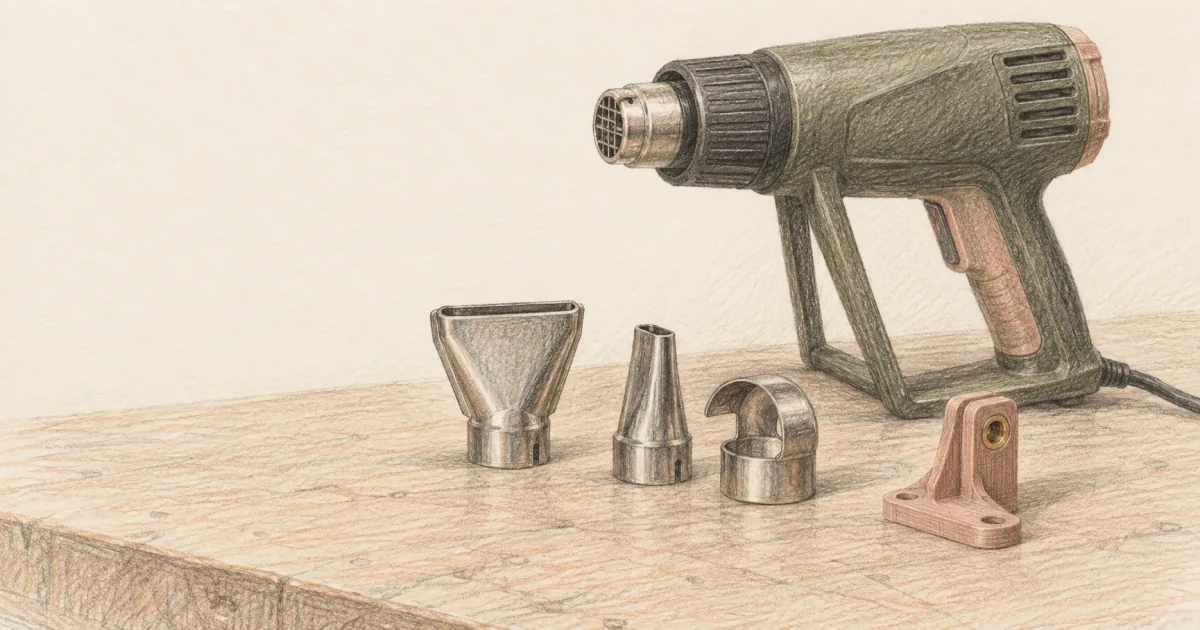
The SEEKONE 1800W Heat Gun runs from 122F to 1202F on a continuous rheostat dial, with a two-position airflow switch and four nozzles: a deflector, two concentrators, and a reflector. It reaches full output in about a second and a half and has an overload cut-out that trips if the rear intake gets blocked.
The dial is why it earns the top slot. Heat-shrink tubing wants roughly 250F, vinyl wants 200F to 300F, and paint stripping wants 900F and up. A two-setting gun does the first two badly and the third well. A dial does all three, which is why this one covers a printing bench and a household repair list at once.
Two habits worth building. Idle the gun on its lowest setting for about 30 seconds before you switch it off, so the fan clears leftover heat out of the barrel. And keep the rear intake clear of dust and filament scraps, because a blocked intake is what triggers the cut-out.
Pick it for inserts, stringing, support work, and everything else on the bench. It is currently about ten percent off list, so it is a fair moment to add one. Skip it if you only ever need gentle heat on tiny parts, where the mini below is easier to aim.
Best for detail work: YEEGEWIN 380W Mini Heat Gun
The YEEGEWIN 380W Mini Heat Gun is a corded pencil-style gun with two temperatures, 480F and 850F, and two airflow levels, 100 and 500 liters per minute. It is UL certified, has overheat protection, a built-in retractable stand, and a 4.9 foot cord.
The low setting is the point. At 480F with the gentler airflow, you can pass heat over a delicate part and watch it react before anything sags. That is the setting for support nubs on a miniature base, thinning a wisp of stringing on a small bracket, or warming a printed clip so it bends without cracking.
Buy it as the second gun, not the only one. It cannot strip paint, and it will not heat a large panel evenly. In exchange it goes places the big gun cannot and is far harder to ruin a part with.
How to set heat-set inserts without melting the boss
Threaded inserts are the single best upgrade for printed parts you take apart. A screw biting raw plastic strips its threads after a few cycles. A brass insert gives you metal threads that last.
Here is the method that works.
- Size the hole to the insert's pilot diameter plus about 0.2 to 0.3 mm, and drill it 2 mm deeper than the insert is tall so the displaced plastic has somewhere to go.
- Print the boss solid. Wall loops or 100 percent infill around the hole stop the surface from sinking.
- Set the gun about 10F above the temperature you printed the part at. Start low, not high.
- Heat the insert for a couple of seconds, then press it in about 80 to 90 percent of the way.
- Flip the part onto a flat heat-resistant surface and press the insert flush from the back.
Two details from people who do this a lot. A round pointed tip seats an insert straight, while a chisel tip tilts it and ruins the hole. And threading a bolt into the insert before you press it keeps plastic out of the threads.
Start temperatures and settings
Treat these as starting points, not numbers to trust. Every gun, nozzle, and filament runs a little differently, and the material in front of you is the only reliable readout.
Mistakes that warp a print
Holding the gun still is the big one. Heat builds in one spot and the plastic moves. Keep the gun moving and let the heat do the work.
Holding it too close is the second. A concentrator nozzle at full power will slump a thin wall in seconds. Back off and use the wider deflector or reflector when you want even coverage.
Chasing a flawless surface is the third. Heat softens and smooths, but it does not fill layer lines. That is a job for sanding and a filler primer. Use the heat gun at the end to even things out, not instead of the sanding step.
Finally, do not reach for heat first on a mechanical problem. A part with a real gap needs a filler or a redesign. Softening it just hides the gap until it opens again.
Bottom line
The SEEKONE 1800W Variable Temp Heat Gun is the best heat gun for 3D printing, with a continuous dial that covers stringing, support removal, and heat-set inserts at a price that leaves room for filament. Add the YEEGEWIN 380W Mini Heat Gun for tight spots and small parts where the big gun cannot aim. Turn it down, keep it moving, and it becomes one of the most used tools on the bench.
Frequently Asked Questions
What is the best heat gun for 3D printing?
A variable-temperature one you can turn down. Two fixed settings force every job into too cool or too hot, and printed plastic lives in the middle. Our top pick is the SEEKONE 1800W Variable Temp. Add the YEEGEWIN 380W Mini for tight spots and small parts.
Can a heat gun remove stringing from a print?
Yes, and it is the fastest fix there is. Turn the heat down, keep the nozzle well back, and sweep it past the strings so they curl and pull in. Do not hold it still. If the surface goes glossy, you are too close or too hot.
What temperature should I use for heat-set inserts?
About 10F above the temperature you printed the part at is a good starting point. Too cool and the insert stops halfway. Too hot and the boss sags. Test on a scrap block with the same wall thickness before you touch a real part.
Will a heat gun ruin a 3D print?
It can if you hold it still or run it at full power. PLA softens fast, and a concentrated nozzle at 400F will slump a thin wall in seconds. Keep the gun moving, keep the nozzle back a few inches, and work in short passes.
Is a mini heat gun better than a full-size one for printing?
They do different jobs. A full-size gun has the airflow and temperature range for larger parts, inserts, and smoothing. A 380W mini reaches into tight spots and runs gentle enough for small brackets, which is where a big gun is awkward.
Do I need heat-set inserts at all?
Only if you take a part apart more than once. A screw straight into plastic strips its threads after a few cycles. A brass insert gives you metal threads and a joint that survives repeated assembly.
Can I use a hair dryer instead?
Not really. A hair dryer tops out well below the range you need for inserts, and the airflow is far too wide to be useful on a small bracket. A cheap variable heat gun costs less than most hair dryers with a concentrator.
Is it safe to use a heat gun indoors?
Work near an open window or in a garage, and keep the gun moving. Heating plastic releases fumes, and older paint can release worse. Never leave a heat gun running unattended, and let it cool fully on its lowest setting before you put it away.