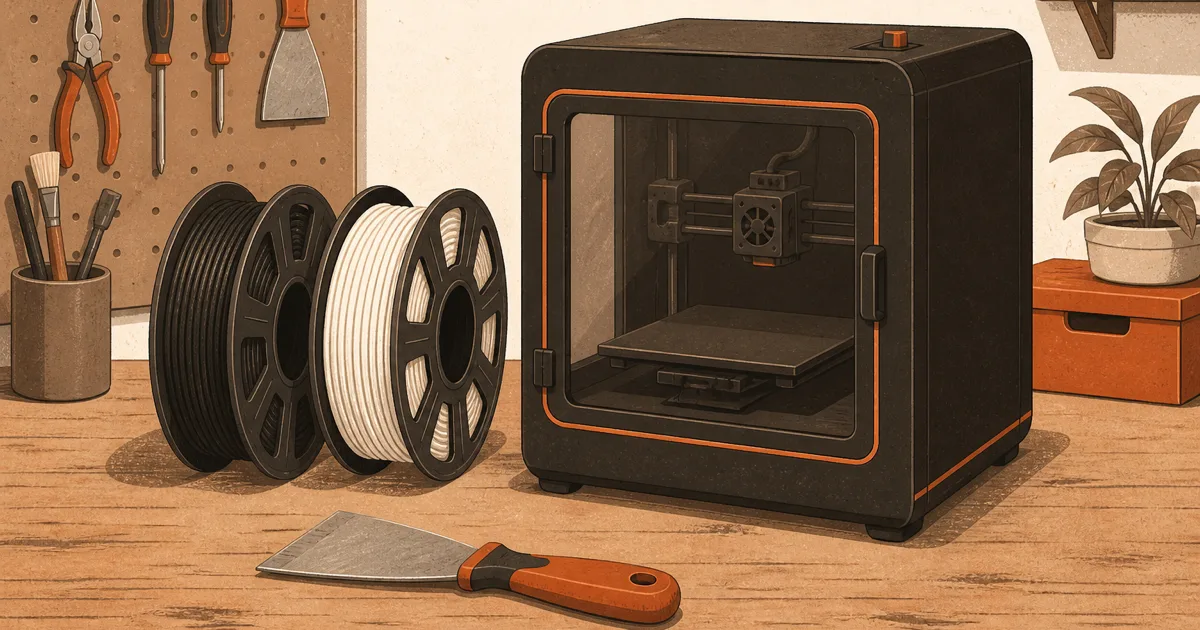
Best ABS Filament: Heat-Tough Spools for Enclosed Home Printers
Filament
The best ABS filament is a reviewed 1.75 mm spool printed in a warm enclosed printer. Hatchbox is the everyday pick. Polymaker is the lower-odor cardboard option, and ELEGOO is the value black roll.
Our picks
The best ABS filament is the spool you can print in a warm, still chamber without turning the room into a chemistry set. Most people land here after a PLA clip sagged in a hot car. They do not need a polymer lecture. They need a 1.75 mm roll, an enclosure plan, and a first-layer habit that is slower than PLA. More spool guides live in our filament guides.
This is a buying guide, not a PLA-versus-ABS debate. For that fork, see PLA vs ABS. For machines that can actually hold heat, see best 3D printer for ABS. Everyday PLA and PETG still live in best 3D printer filament.
What does "best" mean for ABS filament?
A good first ABS spool lists 1.75 mm with a real temperature window, arrives vacuum-sealed with desiccant, and matches an enclosed printer you already have or a tent you will actually use.
Skip any listing that ignores the enclosure
If a listing never mentions an enclosure, bed heat, or styrene smell, move on. ABS is not PLA with extra marketing. The plastic shrinks about 0.8% as it cools, and a draft across a wide part peels the corners up.
Smooth PEI beats textured for ABS
ABS and ASA stick better to smooth PEI than to textured PEI, which is designed more for release. Keep the chamber closed, keep the part fan low for strength, and cool the part to room temperature before you open the door.
Do you actually need an enclosure for ABS?
For reliable home parts, yes. ABS wants a chamber around 40 to 50 °C, and parts over about 50 mm warp without one. A tent can carry a small part, and a sealed machine is the calmer path.
The chamber target is 40 to 50 C
That range is the target. A 100 to 110 °C bed under a cloth cover gets a tent into it, and a best enclosed 3D printer holds it with less fiddling. Below that window, corners lift and layers split.
Soak the bed before the first layer
Heat the bed to about 105 to 110 °C and let the chamber stabilize for 15 to 20 minutes so the frame and rails expand together. Skip the soak and the printer geometry shifts during the first half hour of a long print.
What temperature and bed does ABS want?
Start in the brand's window, often 230 to 260 °C at the nozzle and 95 to 110 °C on the bed, then tune with a small cube. Copying a PLA cooling profile onto ABS is a classic warp recipe.
The heat-deflection row is why ABS is on the page. A part that survives a hot car starts here, while PLA sags.
Best overall: Hatchbox ABS
HATCHBOX ABS is our default answer for the best ABS filament on a home enclosed printer. People have been reprinting this family of spools for years, and that history matters more than a new brand shouting "no warp."
Print it warmer than PLA, with less part cooling, on a heated bed. Keep the door closed. Watch the first two perimeters. A brim on a wide part is not a beginner crutch. It is how ABS corners survive a cool kitchen.
Skip Hatchbox ABS if you only print desk toys and you do not have an enclosure. Buy PLA. ABS will not forgive an open window.
Best for lower odor: Polymaker ABS
Polymaker ABS is the pick when you want a black 1 kg cardboard spool and a resin mix that smells less aggressive than old bulk ABS. Cardboard also plays nicer with many spool holders than a thick plastic reel.
"Lower odor" is not "no odor." Ventilate. Do not park the printer in a bedroom just because the label claims low volatile content. You still want a brim, a heated bed, and a closed chamber for large parts.
Choose Polymaker when black functional parts are the job and you already like cardboard spools for PLA. Choose Hatchbox when you want the longest track record and a color you can match later.
Best value: ELEGOO ABS
ELEGOO ABS is the value black roll when the Hatchbox price jumped and you already own an enclosed machine. ELEGOO is blunt about needing an enclosed printer, which is the honest ABS warning, and its 1 kg line lists a diameter accuracy of about ±0.02 mm.
It is a newer listing than Hatchbox, so you get less color history. For a first black bracket in a P1S-class machine, that is fine. Dry it if the bag sat open. Do not treat "value" as permission to skip the brim.
How should you dry and store ABS?
Keep opened ABS sealed, label the bag with the open date, and dry it if the print looks bubbly or weak. Wet ABS prints like a broken machine, and a dryer is cheaper than blaming the brand.
Label the open date
ABS soaks up moisture from the air, so write the open date on the bag and dry the spool before a long print. A filament dryer is the boring fix that prevents "this ABS is cursed" threads.
Cardboard spools and the AMS
Some automatic color systems feed cardboard cleanly. Some hate it and shed dust. Check the maker's filament list before you load a cardboard ABS roll into an AMS-style unit, or use the external holder and pass the filament through the spool hole when you unload.
Which ABS mistakes waste a spool?
Changing printer, filament, and slicer profile on the same night. Printing a wide tray on an open frame next to a window. Opening the chamber door right after the print finishes, before the part has cooled, which warps it on the way out. Blaming the brand for wet filament.
When is ABS the wrong buy?
Skip ABS if you are still learning first layers on PLA. Skip it if you only have an open-frame printer next to a window and you need a wide part this weekend. Skip it if the real need is outdoor UV, which is closer to ASA.
PETG still sits between PLA and ABS for many clips. If you do not need ABS heat and you do not want ABS smell, stay on PETG.
Bottom line
The best ABS filament for most enclosed home printers is a reviewed 1.75 mm spool printed warm, slow, and dry. Start with HATCHBOX ABS. Use Polymaker ABS when you want a black cardboard spool with a milder smell. Use ELEGOO ABS as the value roll. Match the filament to an enclosure, not to a forum dare.
Frequently Asked Questions
What is the best ABS filament for a first enclosed print?
A reviewed 1.75 mm spool from a brand people keep rebuying. Our top pick is Hatchbox ABS. Skip no-name rolls until a small cube finishes without lifted corners.
Do I need an enclosure to print ABS?
For reliable home parts, yes. Drafts cause warping and layer splits. A tent can help a small part. A true enclosed printer is the calmer path. See our 3D printer enclosure guide if the machine is the bottleneck.
What chamber temperature does ABS need?
ABS wants a chamber around 40 to 50 °C. A 100 to 110 °C bed under a cloth cover gets a tent into that range. Below it, corners lift and layers split, especially on parts wider than about 50 mm.
Is ABS stronger than PLA?
Heat and impact often favor ABS on similar parts. Orientation, walls, and infill still matter more than the name on the spool. A thick PLA clip can beat a thin ABS shell.
What temperature should I use for ABS?
Start in the brand's listed nozzle and bed range, then tune with a small cube. Hatchbox often sits around 210 to 240 °C. Copying a PLA cooling profile onto ABS is a classic warp recipe.
Should I soak the bed before printing ABS?
Yes. Heat the bed to about 105 to 110 °C and let the chamber stabilize for 15 to 20 minutes. The frame and rails expand together, so the printer geometry stops shifting during the first half hour of a long print.
Should ABS filament be dried?
Yes if the bag has been open or the print looks bubbly and weak. Wet ABS prints like a broken machine. A dryer is cheaper than blaming the brand.
Can I print ABS on an open-frame printer?
You can try small parts in a warm, still room. Most home buyers get cleaner ABS in an enclosed printer. Do not start with a wide tray on an open bed next to a window.
Is ABS safe to print at home?
Follow the printer and spool maker's guidance and ventilate. ABS fumes are sharper than PLA. Do not treat a closed bedroom as a print lab.
Should I buy ABS or ASA for outdoor parts?
ABS handles indoor heat and knocks. Year-round sun is closer to ASA. Do not assume a black ABS hook is an outdoor product.