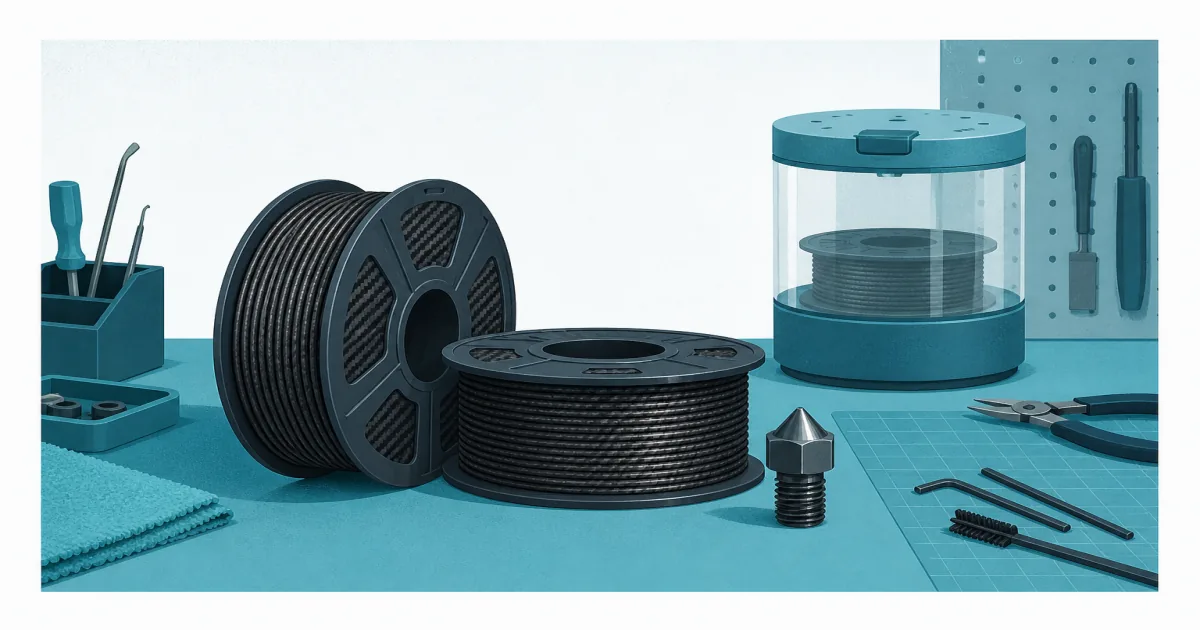
Best Carbon Fiber Filament: Stiffer Parts Without Nozzle Confusion
Filament
Carbon-fiber-filled filament makes sense when you need a stiffer part, not just a cooler spool. Pick the base plastic first, then buy the filament your nozzle and printer can actually support.
Our picks
Carbon-fiber-filled filament sounds simple until people shop by the words “carbon fiber” and ignore the plastic doing the actual work. That is how a maker ends up with nylon-CF on a printer that barely manages dry PETG, or PLA-CF on a part that has to live in summer heat. The filament guides keeps the other specialty rolls together.
This guide is about the spool. If you still need to sort out hardware, start with best 3D printer for carbon fiber and 3D printer nozzles. If the real question is broad day-one material buying, best 3D printer filament is the safer owner page.
Pick the base plastic before the carbon
The chopped fiber changes stiffness, surface feel, and wear on the nozzle. The base plastic still controls the bigger truth. PLA-CF behaves like a stiffer prettier PLA. PETG-CF is the tougher middle lane for mounts and functional parts. Nylon-CF is the serious engineering option when the printer, dry box, and enclosure habits are already in place.
That is why “best carbon fiber filament” is not one single winner. The best one is the material class that matches the part and the printer you already own.
Easiest start: FLASHFORGE Carbon Fiber PETG
FLASHFORGE Carbon Fiber PETG is the easiest first answer because PETG-CF lands in the most practical middle lane. You get more stiffness and a cleaner finish than ordinary PETG, but you do not jump straight into nylon moisture drama.
This is the pick for brackets, tool holders, printer add-ons, and parts that need to feel more rigid than basic PLA. The review trail is much deeper than most niche carbon-fiber listings, which matters because buyer notes are where the boring truth shows up.
You still need a hardened nozzle and dry storage. Carbon fiber does not forgive lazy setup just because PETG is easier than nylon.
Cleaner indoor lane: Creality Hyper Carbon Fiber PLA
Creality Hyper Carbon Fiber PLA is the pick when your real need is an easier, stiffer indoor material. PLA-CF usually prints more calmly than nylon-CF and asks less of the enclosure. It also gives parts a cleaner, more finished look than glossy standard PLA.
That makes it good for enclosures, fixtures, camera mounts, and display-adjacent parts that need more stiffness than plain PLA but do not need hot-car or outdoor performance. If that last sentence describes the job, PLA-CF is smarter than pretending every carbon spool needs to be “engineering grade.”
Skip PLA-CF if the part lives in heat or sun. Carbon does not remove PLA’s basic limits.
Serious option: Polymaker Fiberon PA6-CF20
Polymaker Fiberon PA6-CF20 is the advanced pick because the base plastic matters more here than the carbon does. Nylon-based carbon fiber filament is for makers who actually need more heat tolerance, better strength, and a stiffer engineering part than PETG-CF can usually provide.
That also means more work. Drying matters more. Enclosure habits matter more. The printer matters more. A casual open-frame PLA desk is the wrong home for this spool.
If you are already shopping best 3D printer for nylon, this is the kind of filament lane you are planning for. If you are not, stay on PETG-CF or PLA-CF first.
Quick comparison
That table is more useful than generic “premium” talk because it tells you what to buy for the job you actually have.
The nozzle question is not optional
Carbon-fiber-filled filament is abrasive. That is the one universal rule across PLA-CF, PETG-CF, and nylon-CF. Use a wear-resistant nozzle. If you are still on soft brass, stop and sort that out before the spool arrives.
Our 3D printer nozzles guide is the better next click if your printer setup is still fuzzy. A worn nozzle makes every other tuning note noisier.
Storage and drying matter more as the materials get tougher
PLA-CF is the easiest here, but it still deserves sealed storage. PETG-CF should stay dry. Nylon-CF practically demands dry-box discipline if you want clean repeatable results. If prints start hissing, bubbling, or fuzzing, do not pretend it is a mystery. Dry the spool first.
That is why filament dryer belongs in the same conversation once you leave basic PLA behind. Wet carbon-fiber-filled filament is an expensive way to learn the same lesson twice. If you need plain toughness and heat without fiber fill, compare polycarbonate filament before you buy another abrasive spool.
What parts each lane is good at
PLA-CF is good for rigid indoor parts, jigs, housings, and cosmetic pieces that look nicer when the surface is less glossy. PETG-CF is better for brackets, machine accessories, and functional parts that take knocks. Nylon-CF is where you go when the part has a real mechanical reason for the extra material discipline.
Do not use carbon fiber to dress up weak geometry. A badly designed part does not become stronger because the spool name sounds expensive.
When to skip carbon fiber altogether
Skip carbon fiber if ordinary PLA or PETG already solves the job. Skip it if you still fight first-layer basics. Skip it if your printer cannot take a hardened nozzle or your room storage makes every spool damp by default.
For many people, the better purchase is still the right standard filament from best 3D printer filament, not an early leap into abrasives.
Bottom line
The best carbon fiber filament for most home makers is FLASHFORGE Carbon Fiber PETG because it gives the cleanest mix of functional stiffness, strong review proof, and manageable setup. Choose Creality Hyper Carbon Fiber PLA for easier indoor stiffness, and save Polymaker Fiberon PA6-CF20 for the printer and project that genuinely need nylon-based performance.
Frequently Asked Questions
What is the best carbon fiber filament for most home printers?
Start with PETG-CF. FLASHFORGE Carbon Fiber PETG is the least dramatic path for functional parts when you want stiffness without nylon-level hassle.
Do I need a hardened nozzle for carbon fiber filament?
Yes. Carbon-fiber-filled material is abrasive. A soft brass nozzle is the wrong gamble.
Should I buy PLA-CF, PETG-CF, or nylon-CF first?
Buy PLA-CF for easier indoor parts, PETG-CF for tougher functional parts, and nylon-CF only when you truly need the extra heat and strength.
Is carbon fiber filament stronger than regular filament?
Not in every direction or every use case. It often adds stiffness and cleaner-looking surfaces, but the base plastic and part design still decide whether the print survives.
Can a beginner print carbon fiber filament?
A careful beginner can start with PLA-CF or PETG-CF after learning ordinary PLA first. Nylon-CF is a later step.
Does carbon fiber filament need to stay dry?
Yes, especially nylon-CF and PETG-CF. Wet engineering spools create messy failure loops fast.
Which carbon fiber filament is best for outdoor parts?
Usually PETG-CF or nylon-CF, depending on the load and heat. PLA-CF is the wrong outdoor default.