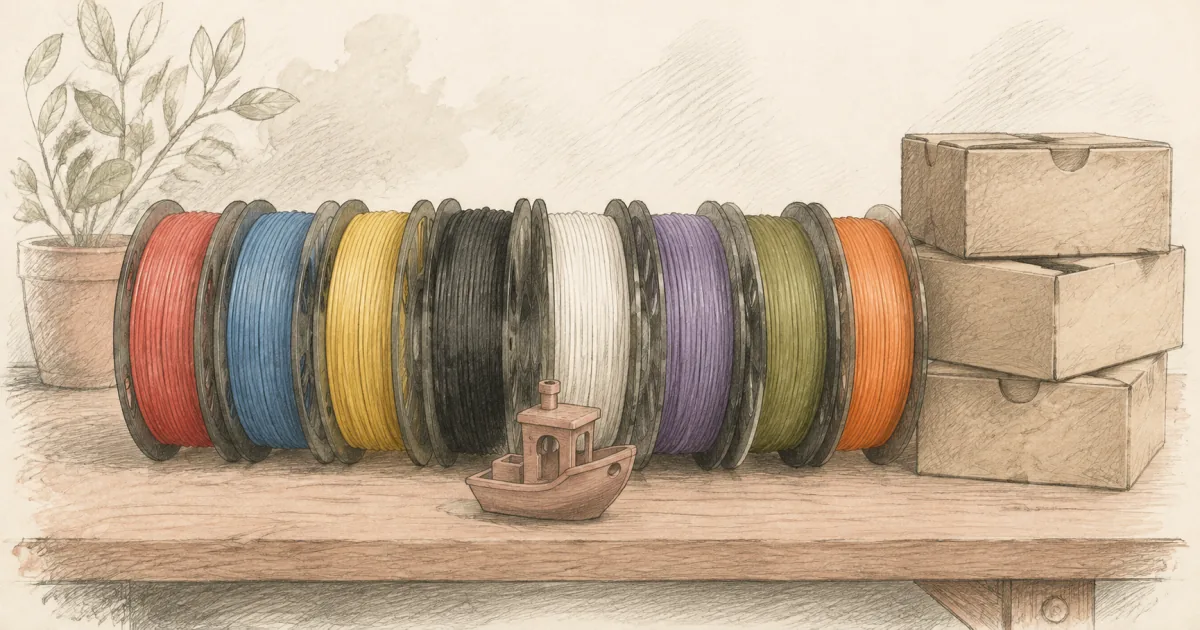
Best 3D Printer Filament Bundle (2026): Cheaper Spools in Bulk
Filament
A filament bundle is the easiest way to try several colors at once without buying six full spools. The right multi-pack gives you 2 to 16 spools for less than the price of two singles, with vacuum sealing and a real finish.
Our picks
A filament bundle is the cheapest way to try several colors without buying six full spools. The right multi-pack gives you two to sixteen spools for less than the price of two singles, with vacuum sealing and a real finish on every spool. The wrong bundle hides thin diameters, dry-box neglect, and colors you will never use.
This guide is for home FDM printers shopping for a starter variety pack. If you only want one color for a single project, the best PLA filament guide or best PETG filament guide is the better shopping list. For a broader filament decision between PLA, PETG, and TPU, see best 3D printer filament and the wider filament guides.
Best overall bundle: SUNLU 16 Color PLA
SUNLU 250G PLA Filament 16 Color Bundle is the smartest starter pack here because it puts sixteen colors on the shelf without sixteen kilograms of commitment. Each spool is 250 g, so the box covers 4 kg in total, and PLA is the forgiving material to learn on. It prints at standard temperatures, has little odor indoors, and behaves the same on almost any machine.
The compact spools are the practical benefit. A 250 g roll is about a quarter the size of a 1 kg spool, which keeps bench clutter down and makes color switching fast. The size also fits a Bambu AMS slot with a printed adapter, so a multi-color machine can use the whole box.
Two honest limits. Small spools run out faster than most beginners expect, so a tall print can eat one before it finishes. And PLA is still PLA, so it softens in a hot car and fades in direct sun. If the parts will sit outside or near heat, step up to PETG instead. The best PETG filament guide and the PLA vs PETG comparison cover when that swap is worth it.
Pick this bundle for color variety on small and mid-size prints, and step up to a full kilogram only for the two or three colors you keep reaching for.
Best silk finish: AMOLEN Silk PLA 4-pack
AMOLEN Silk PLA 3D Printer Filament Bundle is the right pick when the project is a vase, figurine, or display piece that needs a pearlescent finish. Silk PLA hides layer lines without sanding and prints at standard PLA temperatures on a stock brass nozzle. Four 1 kg spools cover serious print volume, so a single spool is enough for several vase-sized projects.
Silk PLA is not for functional parts that take a knock. The finish scratches and shows fingerprints. For functional clips and brackets, the best PETG filament is a better lane. For matte display prints that hide scratches better than silk, see the matte PLA guide.
Pick the AMOLEN Silk PLA 4-pack when the goal is a pearlescent finish on display pieces and the printer can handle a full kilogram spool.
Best 250 g variety: ELEGOO PLA+ 8-pack
ELEGOO 250g Rapid PLA Plus Filament Bundle is the right multi-pack when you want to test color variety on a fast CoreXY printer. The eight 250 g spools are the right size for an AMS slot with an adapter, and the PLA+ formula feeds reliably up to 600 mm/s on Bambu, Creality K1, and Voron printers. The per-spool price is lower than buying the same colors individually, which is the whole point of a bundle.
PLA+ is still PLA-class material, so it softens in a hot car and fades in direct sun. Skip this bundle if your project is an outdoor planter or a clip that sits near a heat source. The PLA vs PETG guide walks through when to step up to PETG.
Pick this bundle for testing colors on a fast printer without committing to a full kilogram of any single spool.
What to look for in a filament bundle
A good bundle has four honest signs. Check them when the box arrives.
A bundle without individual vacuum bags is a risk. Filament absorbs moisture slowly in a sealed bag and quickly in an open warehouse. By the time the box reaches your door, an unsealed spool can already be wet enough to pop at the nozzle.
Spool sizes that actually fit your printer
A 1 kg spool is about 330 m of 1.75 mm filament. It runs out faster than most beginners expect on tall prints and prototypes. A 250 g spool is about 80 m, enough for several small prints or one tall vase. The 250 g size is also lighter, which matters for AMS-style multi-material units that prefer sub-1 kg rolls.
If you print on a Bambu Lab AMS or a Creality K1 with an external spool holder, the 250 g size fits cleanly with a printed adapter. If you print on an open-frame Ender 3 or Prusa MK4, a 1 kg spool is the simpler choice because there is no AMS slot to fill. Match the spool size to the printer, not to the bundle price.
Where to find bulk filament deals
Brand stores are the other half of the bundle market. Polymaker runs a bundle builder, Overture and ELEGOO sell their own multi-packs, and Prusa lists filament bundles next to its printers. Those pages are worth a look when you want to mix brands or add a large single-color spool to the order.
Deals cluster around two moments: a new printer launch and a holiday sale. That is when a multi-pack drops well below list price, and also when the same discount shows up on the Amazon listing as a percentage off. Buy the material you already print when it drops. Buying a material you have never run because the price looked good is how spools end up unopened.
For a single color you burn through, a 3 kg or 5 kg spool beats every bundle on cost per kilogram. It only wins if you have a holder that takes the weight and you actually print that one color.
How to store unopened spools so they stay dry
Keep unopened spools in their original vacuum bags until you need them. Move opened spools to a dry bag with a fresh desiccant packet the same day you open them. PETG and silk blends absorb moisture faster than PLA, so they go back into the dry bag the same night you print.
A 40 to 45 C filament dryer is the safer call for spools you cracked open last month. The filament dryer guide and the filament storage guide cover both setups. A wet spool looks like a hardware failure: popping sounds at the nozzle, fuzzy surface finish, and stringing that came out of nowhere. Fix the storage before you tear down the hotend.
When a single spool beats a bundle
A bundle is the wrong shape when you only want one or two colors for a specific project. Sitting on ten spools of colors you do not use is not a savings. A single 1 kg spool is the cleaner answer for a focused build, and the best PLA filament guide is the better shopping list.
A bundle is also the wrong shape for a first spool ever. Buy one reputable PLA spool, finish a calibration cube, then graduate to a bundle once you trust the printer. The best 3D printer for beginners covers the machine side of that first month.
Bottom line
A filament bundle is the cheapest way to try multiple colors and materials in one order. SUNLU 16 Color PLA is the smartest starter for a shelf of shades without sixteen kilograms of commitment. AMOLEN Silk PLA wins for vases and display pieces that want a pearlescent finish.
ELEGOO 250 g PLA+ 8-pack is the right call when you want color variety on a fast CoreXY without committing to a full kilogram of any single spool. Match the bundle to the material you actually print, not to the loudest color in the box.
For a broader filament decision between PLA, PETG, and TPU, see best 3D printer filament and the wider filament guides. For a printer that handles any of these bundles cleanly, see best 3D printer.
Frequently Asked Questions
What is a 3D printer filament bundle?
A 3D printer filament bundle is two or more spools sold together, usually as a multi-pack of the same material in different colors. Some bundles mix materials, but most bundles are color variety packs of PLA, PETG, or silk blends. The price per kilogram is usually lower than buying the same colors one spool at a time.
Where is the cheapest place to buy 3D filament?
Per kilogram, a bundle is usually the cheapest route, and a 16-pack of 250 g spools is often the lowest price per spool of anything on the shelf. Brand stores run bundle builders with their own bulk pricing, and Amazon multi-packs land close to that with faster shipping. The cheapest option overall is a refill or large spool in a single color, but that only wins if you actually print that one color.
Where can I buy bulk 3D printer filament?
Three places, in order of convenience. Amazon multi-packs for a mix of colors with two-day shipping. A brand store like Polymaker, Overture, or ELEGOO for a bundle builder and larger single-color spools. A 3 kg or 5 kg spool for a single color you burn through, which is the lowest cost per kilogram if you have a place to hang it.
Is it cheaper to buy the thing or 3D print it?
It depends on the part. A small plastic bracket costs a few cents of filament to print and takes an hour of machine time, which beats paying for a replacement that may not exist anymore. A large, dense object can burn through a full spool, and at that point buying the item is cheaper. Print the small, specific, or discontinued parts and buy the big simple ones.
Where can I find bulk filament deals?
Watch two places. Brand stores run bundle sales tied to holidays and new printer launches, which is when a 10-pack drops well below its list price. Amazon multi-packs show the same discounts as a percentage off list, and the deal flags come and go. The reliable move is to buy the material you already print when it drops, not to buy a material you have never run because the price looked good.
Is a filament bundle cheaper than buying spools separately?
Usually, yes. A typical 8-pack of 250 g spools lands around 30 to 40% less than the same colors bought one at a time. Bigger 16-packs of 250 g spools can drop the per-spool price even further. The math flips if you only want one or two colors, because you will sit on spools you do not use.
Can I mix PETG and PLA in the same bundle?
Most bundles keep one material across the pack so you do not have to purge and re-temp between colors. Mixing PLA and PETG in the same bundle is rare for that reason. If you want both, buy the PETG bundle and the PLA bundle separately. AMS-style units let you load PLA on one slot and PETG on another without unloading.
Will filament bundles work in a Bambu Lab AMS?
Most 1 kg cardboard spools fit an AMS slot directly. Smaller 250 g spools usually need a printed adapter to lock the hub into the AMS channel. The adapter is a short print and the file is on MakerWorld. A few bundle spools ship with the adapter already printed and taped to the box.
What is the difference between 1 kg and 250 g spools?
A 1 kg spool is about 330 m of 1.75 mm filament and runs out faster than most beginners expect. A 250 g spool is closer to 80 m, enough for dozens of small prints but it runs out mid-week on tall jobs. The 250 g spool is also lighter, which matters for AMS-style systems that prefer sub-1 kg rolls.
How do I keep an opened bundle dry?
Vacuum-sealed dry bags with a fresh desiccant packet handle the spools you opened this week. For spools you cracked last month and pulled out twice, a 40 to 45 C dryer box is the safer call. PETG and silk blends absorb moisture faster than PLA, so they should go back into the dry bag the same night you print. The filament dryer guide and the filament storage guide walk through both setups.
Can I print silk PLA on a regular brass nozzle?
Yes. Silk PLA is not abrasive, so a stock brass 0.4 mm nozzle handles it cleanly. Carbon fiber and glow filaments are different and want a hardened steel nozzle. Silk PLA prints at the same 200 to 215 C range as regular PLA and uses the same textured PEI sheet for the first layer.