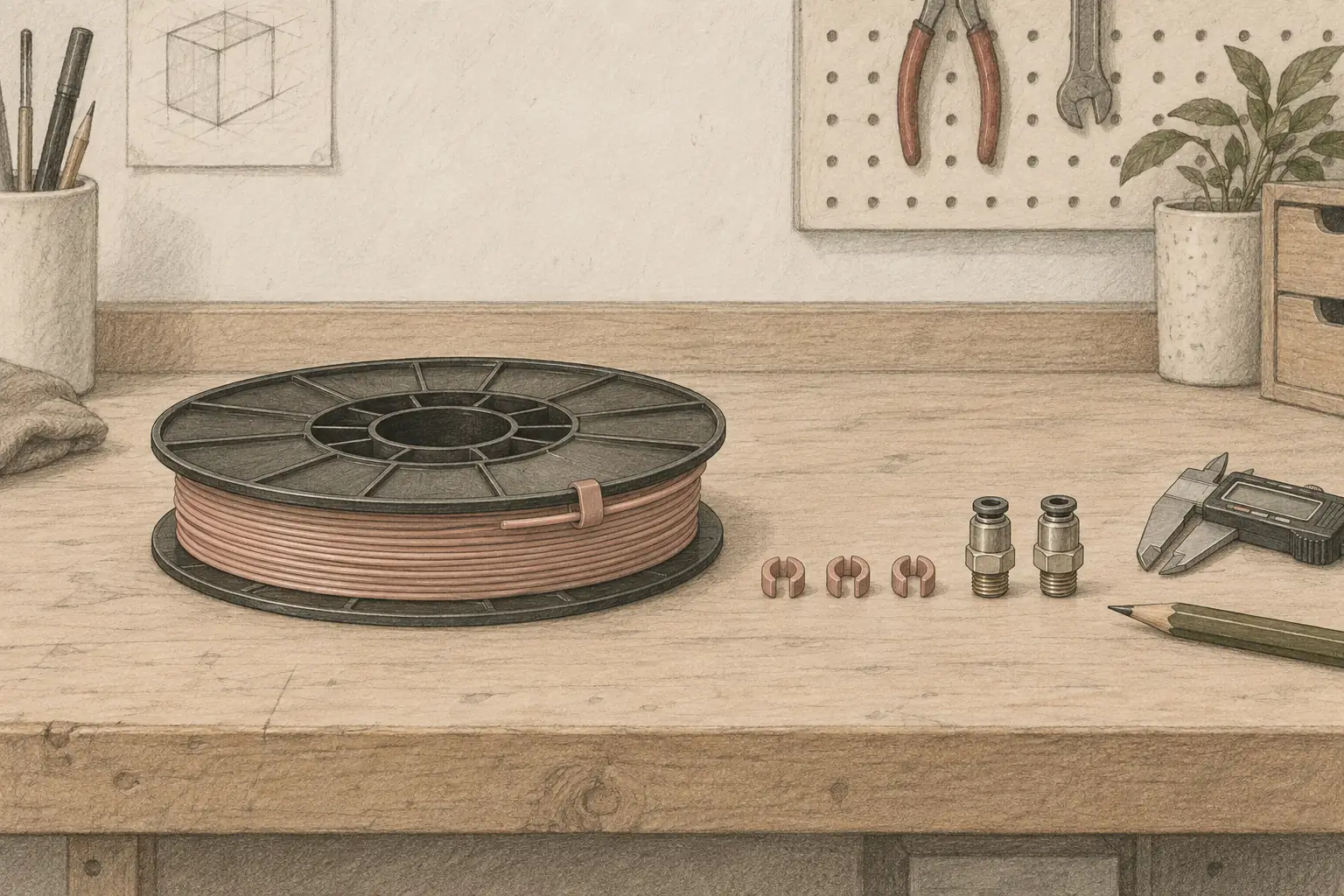
Filament Clips: Which Kind You Need and What to Buy
Filament
Most filament clips are spool clips you should print instead of buying, because the free models fit better than the no-name packs. The clip that locks a Bowden tube into its coupler is the one worth paying for.
Our picks
Filament clips are two different parts wearing one name, and that is the whole reason this search is frustrating. A spool clip holds a loose filament end against the spool so the strand cannot unwind into a hidden tangle, and the best ones are printed rather than bought.
A collet clip, often called a Bowden clip, locks the PTFE tube into the push fitting on the extruder, and that is the job worth paying for. The Iffitya 40PCS Bowden Tube Coupler Set is the pick we keep on the bench, and the section below explains why.
This guide splits the two jobs, says when printing beats buying, and gives you the sizes and the per-clip cost. Browse the rest of our filament guides, start from the best 3D printer filament pillar if you are still choosing a material, and pair this with filament storage so the spool stays dry.
What is a filament clip actually for?
A filament clip stops a spool from unwinding itself and stops a tube from leaving its coupler. Those are the only two jobs, and they need different parts, different sizes and different buying decisions.
The spool clip job
A spool clip clamps the loose end of the filament to the spool rim. Without one, the tail springs free, loops under a lower strand, and creates the tangle that ruins an overnight print. Most owners meet this problem on the second spool, not the first.
The fix is a printed part. A print-in-place spool clip finishes in under 4 minutes at 0.16 mm to 0.2 mm layers with 2 walls and 5 to 10 percent infill, and it needs no supports. A well-designed universal version grips spool rims from about 1.5 mm to 5.5 mm thick and covers spools from 200 g to 3 kg.
PETG, ABS or ASA beats PLA here. The clip is a spring, and a printed PLA spring gets brittle after enough bends. Print a small pile in one go and treat them as consumables.
The coupler clip job
The other filament clip is the pre-tension shim that slides under the toothed collet on a push fitting. The collet holds the PTFE tube with 4 tiny metal blades. The clip presses the collet tighter so the blades keep their grip and the coupling stops wiggling.
This matters more than it sounds. When a Bowden tube slides out of its fitting, the extruder keeps feeding and the filament coils into empty space. You lose the print, and on a long job you can clog the hot end while the material degrades with nowhere to go.
Which kind of filament clip do you need?
If your problem is a loose spool end, you need a spool clip. If your problem is a tube that moves, pulls out, or leaks at the fitting, you need a collet clip. Match the symptom, not the product name.
A quick test: hold the clip next to the problem. If it has to wrap around a spool edge, it is a spool clip. If it has to sit in a ring around a tube, it is a collet clip. They are not interchangeable, and no listing that mixes them will help you.
Should you print filament clips or buy them?
Print the spool clips and buy the collet clips. A printed spool clip costs a few cents and fits better than the packs on sale, while a collet clip is a molded part that belongs in a bag of spares.
What a printed spool clip costs and how long it takes
One spool clip is a couple of grams of filament, so a batch of 20 costs less than a dollar in material and about half an hour on the plate. Print them in PETG if you have it, because the spring survives repeated bending far better than PLA.
Two design details are worth knowing before you download anything. Clips that grip the filament itself, rather than the spool rim, can ride down into the filament insert on an automatic material system and jam it, so take them off before loading a spool. And a clip that hugs the outer rim can foul the internal rollers of a closed multi-spool unit, which is why some designers tell you to remove it before a print starts.
Why the cheap Amazon spool clip packs are not worth it
The spool clips sold on Amazon are mostly unbranded listings with no meaningful review history. A 10-pack we checked runs $18.99 and carries no star rating at all, and the closest comparison in the same rail shows a single rating. That is not a product with a track record, it is a repackaged STL you can print yourself for pennies.
There is one exception worth having in a drawer: a plain small binder clip. It is tempered steel, it costs about 10 cents, and it holds a tail against a rim without any printing at all. It is the honest answer for the one spool you keep meaning to organize.
Best collet clip set: Iffitya 40PCS Bowden Tube Coupler Set
The Iffitya 40PCS Bowden Tube Coupler Set is the pick we reach for first. You get 20 collets and 20 clips for about $6.99, which is roughly $0.17 per collet and clip pair. For comparison, a single loose PC4-M10 pneumatic fitting in the same listing rail runs about $0.44, so replacing the whole coupling instead of just the clip costs more than two and a half times as much per joint.
Fit is the part that catches people. These are sized for 4 mm outside-diameter PTFE tube on 1.75 mm filament machines, and they are listed as compatible with Creality all-metal hot ends and similar fittings. Check the outside diameter printed on your tube before you order. If your machine uses a different fitting family, the clip will not seat and the tube will still move.
The set earns its place because tube-pop is a wear problem, not a one-time fault. The blades inside a collet scrape the tube every time you remove and refit it, and a high-hours owner reports inspecting the fitting every 200 hours and renewing the extruder's PTFE insert around every 500 hours. Having 20 spare pairs means you stop rationing them.
Best value collet clips: Niuohoy 40PCS Bowden Collet and Clip Set
The Niuohoy 40PCS Bowden Collet and Clip Set is the value alternative. It is 20 sets, meaning 20 collets and 20 matching clips, for about $5.99. That works out to roughly $0.30 per set, so it costs less up front than a bulkier pack and more per part once you count them.
Buy this one if you want a single tidy bag and you are not planning a fleet of machines. Buy the 40-piece set above if you would rather not think about it again for a year. Either way, order the clips with the collets. A clip on a worn collet is a temporary fix, and the pair is what holds the tube.
Best spool-end clip without a printer: Mr. Pen Small Binder Clips
The Mr. Pen Small Binder Clips are the no-printer answer for spool ends. Fifty 0.75 inch tempered steel clips cost about $4.85, which is roughly $0.10 each, so clipping 20 spools costs about $2. That is cheaper than a single roll of the filament you are trying to protect.
They are not elegant. A binder clip does not have a filament channel, so the tail sits against the rim rather than in a groove, and on a very thin spool the jaw overhangs. What they do have is spring steel that does not care how many times you open it. Keep a handful on the shelf and stop hunting for the printed clip you left on the last spool.
If you would rather print, see our notes on how to dry filament for the storage side of the same habit. Dry spools and clipped tails are the two cheapest habits in this hobby.
How much should filament clips cost?
A printed spool clip should cost you pennies. A collet and clip set should cost about $6 to $7 for 40 pieces, and a binder clip about 10 cents. Anything above that is paying for packaging.
Run that last row twice before you replace a coupling because the clip fell off. A clip is the cheap part and the collet is the cheap part. The fitting and the tube are the expensive ones, and both last longer when the clip is doing its job.
How do you stop a Bowden tube popping out mid-print?
Fit the clip, seat the tube properly, and trim the damaged end. Most tube-pop cases come down to a clip that was never installed, a tube that was not pushed in until it locked twice, or a tube end that the collet blades have already chewed smooth.
Trim 3 to 4 mm off a chewed tube end
The blades inside a collet scrape the tube's outer surface every time you pull it out. Once that surface is smooth, the grip is gone even with a perfect clip. Cut 3 to 4 mm off the end, keep the cut square, and refit. A square cut matters because a sloped end leaves a gap against the heat break and causes extrusion problems later.
Do not do this indefinitely. Every trim shortens the tube and changes the path. When the tube has been trimmed twice and still slips, replace it. A new length of PTFE tube is cheaper than the failed print that finally convinces you.
When the collet is the problem, not the clip
If a fresh clip and a fresh tube end still will not hold, look at the collet itself. The ring of teeth can break, and Creality owners report the fragments scattering into the hot end, which turns a loose tube into a jam and a cleanup. Pull the fitting, look at the blades, and replace the collet if the ring is damaged.
One more thing to check before you blame the hardware: push the tube in until it locks, then push again. Plenty of owners have chased a fitting problem that was a tube that felt seated and was not. Do that before you order parts, and keep a pair of clips in the spares box either way.
What to skip
Skip any clip that grips the filament rather than the spool rim if you use an automatic material system, because it can ride into the filament insert and jam. Skip a clip printed in PLA if the spool lives anywhere warm, because the spring softens and the grip goes. And skip the idea that a clip fixes wet filament. Popping, bubbling and weak layers are a drying problem, and our filament dryer guide covers that separately.
Bottom line
Most filament clips are spool clips, and the right move is to print them in PETG and keep a handful on the shelf. For the clip that locks a PTFE tube into its coupler, buy the Iffitya 40PCS Bowden Tube Coupler Set at about $6.99 and keep the spares in the drawer.
The Niuohoy 40PCS Collet and Clip Set is the cheaper single purchase if you only want one bag. If you have no printer, the Mr. Pen Small Binder Clips do the spool job for about 10 cents a clip. Match the clip to the symptom and you will stop losing prints to a two-cent part.
Frequently Asked Questions
What is the point of a filament clip?
It holds a loose filament end against the spool so the strand cannot unwind into a hidden tangle. The other part with the same name holds a PTFE tube inside its coupler so the tube cannot pop out mid-print.
Are filament clips for the spool or for the Bowden tube?
Both, which is why the search results are confusing. A spool clip holds the filament end. A collet clip, often called a Bowden clip, holds the tube. They are different parts for different jobs.
Should I print filament clips or buy them?
Print the spool clips. A free model prints in a few minutes and fits better than the no-name packs, which carry almost no review history. Buy the collet clips, because that is a small molded part you cannot print in ABS.
How much do filament clips cost?
A printed spool clip costs a few cents of filament and nothing else. A 40-piece collet and clip set runs about $6 to $7, which is roughly 17 to 30 cents per collet and clip pair.
Why did my filament clip jam inside the AMS?
A clip that grips the filament itself can ride down into the filament insert when the spool turns. Take those clips off before you load a spool into any automatic material system, and keep the clip in a drawer instead.
What size collet clip do I need?
Match the coupler, not the printer brand. Most home FDM machines use 4 mm outside-diameter PTFE tube with PC4-M6 or PC4-M10 push fittings, and the clip is sized to that collet.
How do I stop a Bowden tube popping out mid-print?
Seat the clip under the collet, push the tube in until it locks twice, and trim 3 to 4 mm off a chewed tube end so the blades bite fresh PTFE. Inspect the fitting every 200 hours or so.
Does a filament clip help with wet filament?
No. A clip is mechanical, not chemical. If prints are popping and stringing, dry the spool and store it sealed. Clips only stop the strand from unwinding.