3D Printer Filament Dryer: Do You Need One and Which to Buy
Filament
Wet filament prints like a broken machine. Most home benches only need one small heated box, the SUNLU S1 Plus, while nylon and four-spool setups want the Creality Space Pi X4.
Our picks
Wet filament prints like a broken machine. Stringing, popping, and weak layers usually come from the spool soaking up air, not from a bad printer, and a 3D printer filament dryer removes that moisture by holding the spool at a set temperature for a few hours.
Most people over-buy here. A beginner with one PLA spool can wait. The moment you add PETG, TPU, or nylon, a dryer stops being optional. This page tells you whether you need one, which temperature your plastic wants, and which of three boxes fits your bench. For the full shelf, see our best filament dryer roundup and the filament guides; if you already own a box, the how to dry filament walkthrough covers the routine.
Do you actually need a 3D printer filament dryer?
You need one once you print PETG, TPU, nylon, or ASA, or once PLA starts popping on the first layer. Sealed PLA off a fresh spool prints fine dry, so a beginner can wait. Everyone past that is guessing without one.
When PLA is fine without a dryer
A sealed spool of PLA you opened this month usually prints clean. PLA absorbs moisture slowly, and a dry room keeps it usable for weeks. If your prints look good and a bent strand does not hiss, you have time before you need anything new.
When a dryer stops being optional
Add a second material and the math changes. PETG, TPU, nylon, and ASA pull moisture out of the air faster and show it at once: popping in the nozzle, fuzzy stringing, and walls that split. Nylon is the worst of them and can turn unusable after a week open in a humid house.
The cheap test costs nothing. Watch the first layer for small bubbles and listen for a hiss at the nozzle. If you hear either one, dry the spool before you touch the slicer.
What temperature does each filament actually need?
The right temperature depends on the plastic, and it is the one number that rules out half the dryers on the shelf. Buy for your hottest material, not the one you use most.
Why a 55°C box cannot fix nylon
Many popular boxes top out at 55°C, which is perfect for PLA and TPU and useless for nylon. Owners trying to dry nylon find the chamber sits near 63°C even when they ask for more, and the moisture reading barely moves. Nothing is broken here. The box is running at its ceiling.
If nylon, polycarbonate, or carbon-filled blends are in your future, skip the budget boxes and buy the one that reaches 80°C or higher. Buying a 55°C box twice costs more than buying the right box once.
Why the number on the screen is only a guide
Chamber temperature drifts from the setpoint, and some budget controllers read low or high by several degrees. One owner's homebuilt controller read about 20°C below a calibrated thermometer. Trust the plastic more than the display: if the spool still strings after a full cycle, add time or a few degrees and test again.
Which type of dryer fits your bench?
Dryers come in three shapes, and the shape matters more than the badge. Pick by how many spools you keep open and how hot you need to go.
Single-spool boxes
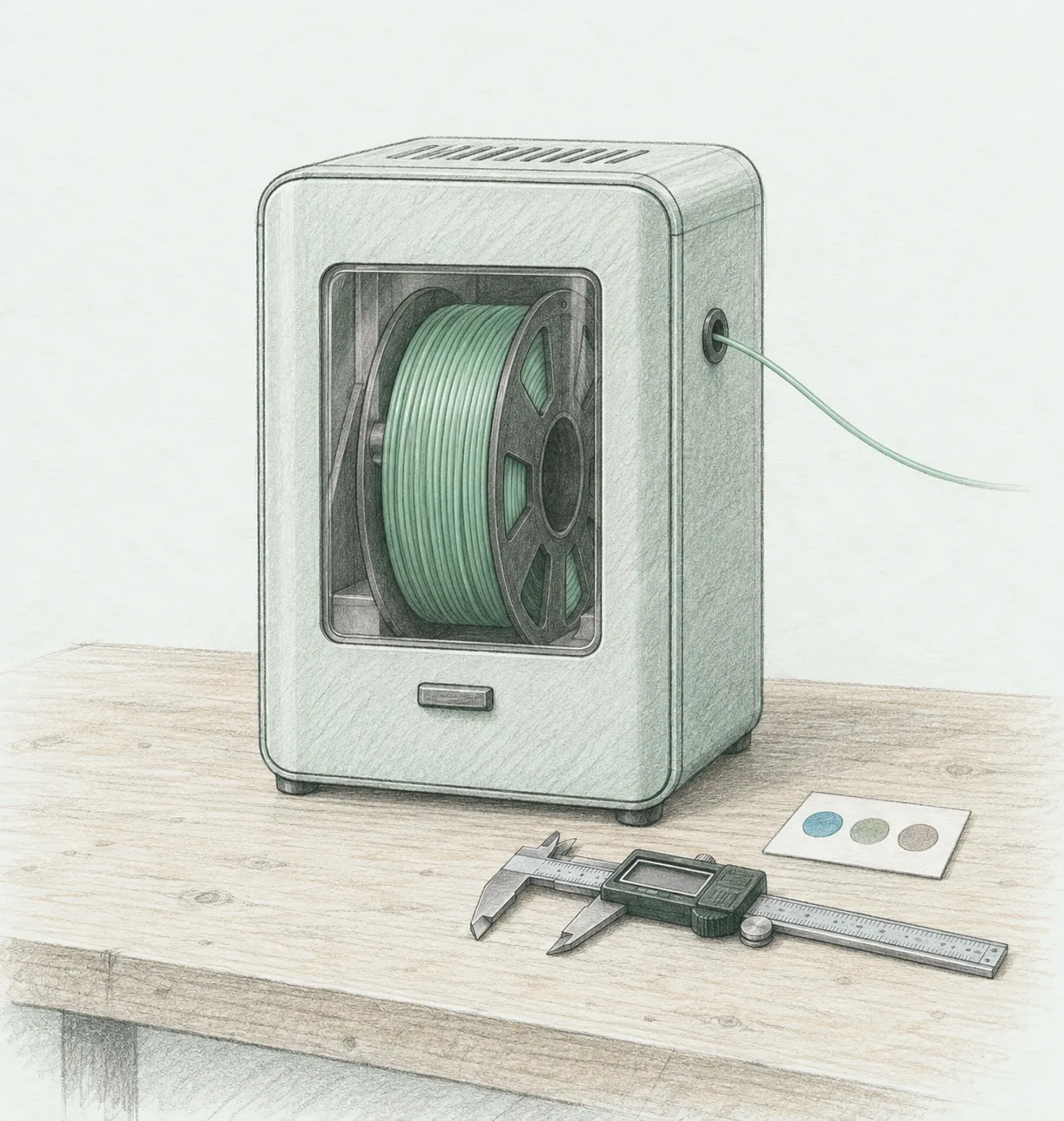
The single-spool box is the safe default. It sits on the bench, holds one 1 kg spool, and dries it in a few hours. The best ones feed filament out of the box and into the printer, so the spool stays dry through a long job instead of sitting in open air.
Four-spool dryers and heated storage
Once you run an automatic color system, a one-spool box becomes a bottleneck. A four-spool dryer holds a whole run of colors and doubles as heated storage, so loaded spools stay ready between prints. That heated storage is the main reason people buy a four-spool box.
Which filament dryer should you buy?
Three boxes cover almost every home bench: a budget single-spool unit, a mid-priced box that reaches PETG temperatures, and a high-temperature four-spool dryer. All three are sealed, heated, and sold on US Amazon.
Best overall: SUNLU Filament Dryer Box S1 Plus
The SUNLU Filament Dryer Box S1 Plus is the pick we hand most people first. It costs about $32, holds one 1 kg spool, and covers PLA, PETG, TPU, ABS, and nylon on paper with a 35 to 55°C range and a timer that runs to 24 hours.
Two things make it worth the small step up from a bare heating box. The current revision adds a circulating fan, so the heat moves instead of pooling under the spool. And the feed path lets you print from the box, which is the difference between drying once and keeping a spool dry all week.
Temperature is the one limit. SUNLU caps it at 55°C, and the box wants an ambient room between 20 and 35°C. Below about 10°C it may not reach the preset at all, so a cold garage is the wrong home for it. For PLA and TPU that ceiling never matters. For nylon it does.
If you keep more than two colors open, pair this with sealed boxes from our filament storage guide and add desiccant beads once the spool is dry.
Best value: Creality Space Pi SE (Dryer Box 2.0)
The Creality Space Pi SE, also sold as the Dryer Box 2.0, is the value pick at about $40. Its PTC heater and fan reach 65°C in roughly 15 minutes and hold it, which covers PLA, PETG, TPU, ABS, and ASA, the materials most home printers actually run.
Real-time humidity monitoring is what we watch most. You set a target and a timer from 0 to 24 hours, then read the humidity falling instead of guessing when the spool is ready. Creality still suggests moving the dry spool into a vacuum bag afterwards, and skipping that step can waste the whole cycle.
Noise is the one thing to know before you buy. A sound-level reading on a Creality box of this class landed near 55 to 65 dB, louder than a small SUNLU. In a shared room that is audible. Pair it with our best PETG filament picks and the PETG side of your shelf is covered.
Best for high-temperature filaments: Creality Space Pi X4
The Creality Space Pi X4 is the pick for anyone printing nylon, PC, or ASA, or running four colors at once. Two independent 200W chambers reach 85°C, hold four 1 kg spools or two 2 kg spools, and double as heated storage that keeps moisture from creeping back in.
Temperature is why it exists. Budget boxes stall near 55°C, and even the mid-priced boxes top out around 65°C. The X4 reaches the 80 to 85°C band that engineering filaments and carbon-filled blends want, and owners who print those materials tend to keep it.
A few quirks come with the price. The auto-dry routine applies one temperature to both chambers, so if you dry PETG on the left and PLA on the right, start each side by hand instead. The rollers are molded plastic rather than metal, and the display humidity can read high against a separate meter. None of that stops it from reaching temperatures the others cannot.
Do you need desiccant in the dryer?
Desiccant is for storage, not for rescuing a wet spool. A silica pack keeps a dry spool dry, but it will not pull the moisture out of a spool that already soaked it up. Dry first, then seal.
Think of it as two jobs. The dryer does the heavy lifting and removes moisture with heat and time. The desiccant holds the line afterwards, in the box, in a sealed bag, or in the feeder. Skip the dryer and the desiccant just changes color while the spool stays wet.
Is it possible to print when the air is 60% humidity?
Yes, but you have to dry on a schedule instead of once. Above 60% relative humidity an open spool re-absorbs moisture within days, so plan a drying cycle before any long print rather than trusting the sealed bag.
Humidity is the hidden variable in a lot of bad-filament stories. In a dry room a spool stays usable for weeks. In a damp basement or a coastal garage it can be wet again in three days. Owners in humid climates report their storage silica changing color within days when the lid is not sealed.
The fix is simple and mechanical. Keep spools in sealed boxes, dry the one that is open, and let the dryer run while you print. That loop keeps the material stable through a humid month.
What to skip
Skip a 55°C box if nylon is on your list, because it will never reach the temperature that material needs. Skip a four-spool dryer if you print one color at a time, because the extra capacity just takes up bench space. And skip the idea that a sealed bag alone will dry a spool. Bags slow moisture down. They do not remove it.
Bottom line
Most home benches need one small heated box, and the SUNLU Filament Dryer Box S1 Plus at about $32 covers PLA, PETG, and TPU with a fan and a feed path that keeps working during a print. Step up to the Creality Space Pi SE when PETG and ASA are routine and you want 65°C. Buy the Creality Space Pi X4 only when nylon or four spools at once make the 85°C ceiling worth the $159.
Match the box to your hottest material and your busiest bench, and the stringing and popping go away for good.
Frequently Asked Questions
Do I really need a filament dryer for PLA?
Not for a fresh sealed spool. PLA absorbs moisture slowly and prints clean for weeks in a dry room. Once you print PETG, TPU, nylon or ASA, or once your PLA starts popping and stringing, a dryer becomes the cheaper fix.
Which filament dryer is best for high temperatures?
The Creality Space Pi X4 is the box in this group that reaches 85°C, which is the range nylon, polycarbonate and ASA want. Most budget dryers stop at 55 to 65°C and cannot dry those materials no matter how long you run them.
What temperature should I dry PETG at?
Dry PETG between 60 and 65°C for four to six hours. That is above the 55°C ceiling on the cheapest boxes, which is why a PETG-only bench should skip them and start at the Creality Space Pi SE.
Do I need to put desiccant in my filament dryer?
Desiccant is for storage, not for drying. It keeps an already dry spool dry in a box or sealed bag, but it will not pull moisture out of a spool that has already soaked it up. Dry first, then seal.
Is it possible to 3D print in 60% humidity?
Yes, if you dry on a schedule. Above 60% relative humidity an open spool re-absorbs moisture within days, so plan a drying cycle before any long print instead of trusting a bag to hold it.
How long does it take to dry filament?
PLA takes about four to six hours, PETG about four to six at a higher temperature, and nylon eight to sixteen. Most boxes default to a six hour cycle, and the timer runs up to 24 hours on the picks here.
Can a filament dryer double as storage?
A sealed box can hold spools dry between prints, which is the main reason owners buy a four-spool dryer. For long-term storage still move the spool to a vacuum bag or an airtight container with desiccant.
Why is my filament still stringing after drying?
Either the temperature was too low for the plastic or the cycle was too short. Nylon and PC need 80°C and up, which a 55°C box cannot reach. Raise the time first, then the temperature, and try a small test print.