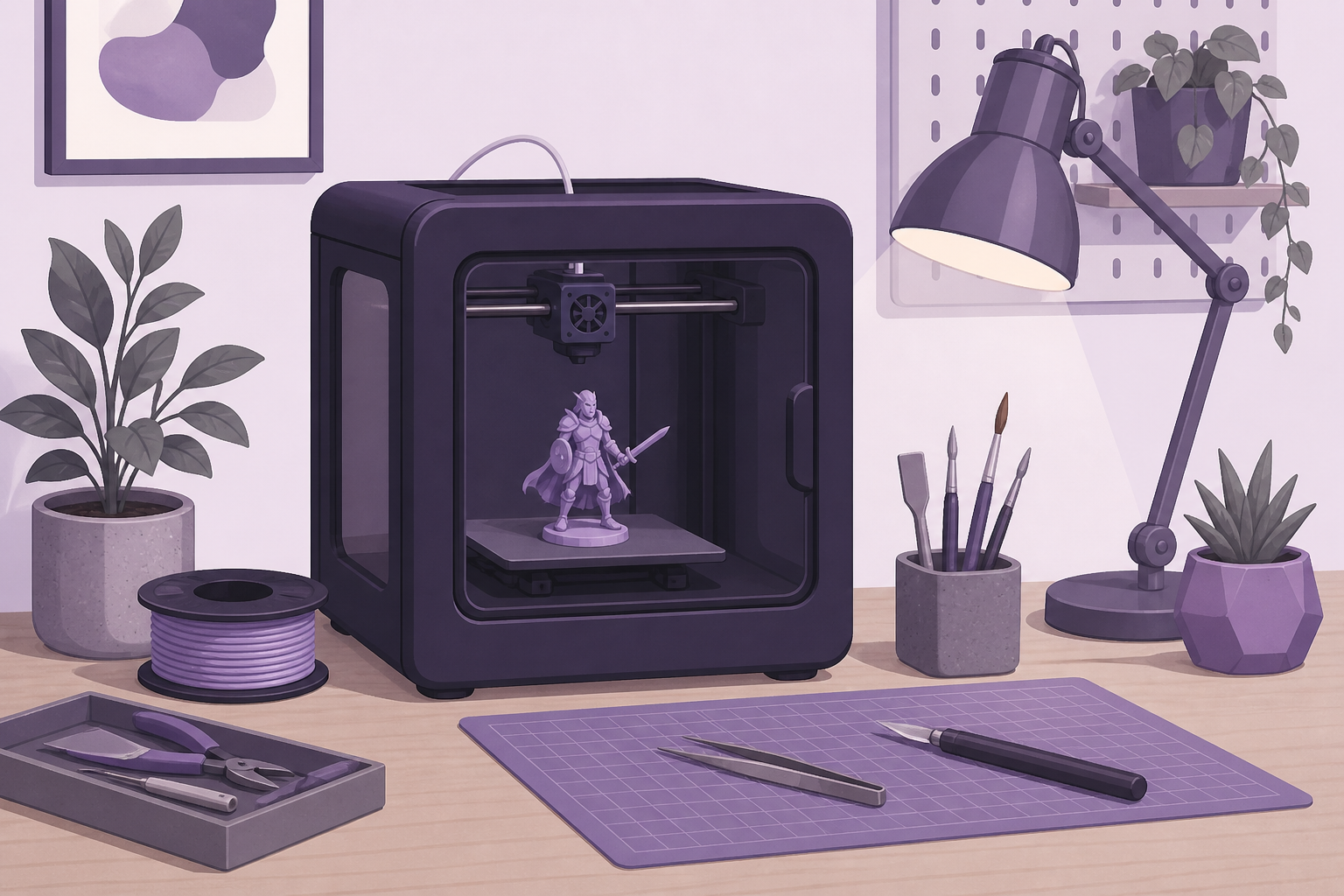
Best 3D Printer for Miniatures (2026): Resin Picks for Tiny Detail
Resin
For tiny faces, armor, and tabletop pieces, a compact resin printer usually prints cleaner detail than FDM. Match the plate size to your models and leave room for washing and curing.
Our picks
The best 3D printer for miniatures is usually a resin printer, not because FDM is bad, but because miniature surfaces ask for tiny details. Resin handles faces, chain mail, and small text with less visible layering. FDM is still useful for terrain, organizers, and big props. It is simply not the easiest path to a clean 28 mm figure. Browse more detail-minded machines in our resin guides.
What you are really choosing is plate size and how much cleanup you will tolerate. A compact machine keeps resin volume and failed prints small. A larger plate is worth it when you regularly print terrain, vehicles, or a squad at once. Either way, plan wash and cure space before the printer arrives. For the wider lane, read best resin 3D printer, and for the bottle itself see best resin for miniatures.
Resin or FDM for miniatures?
Resin gives you sharper detail, and FDM keeps cost, mess, and size in your favor. For 28 mm figures with faces and armor, resin is the tool. For a modular dungeon wall, a movement tray, or a helmet-sized prop, FDM is cheaper, cleaner, and faster.
Why 10K numbers are not the whole story
Resolution helps, but the light source and exposure control matter as much. A 10K screen with uneven light gives softer edges than a well-tuned lower-resolution machine. Do not buy a huge printer just because the box says 16K. Match the plate to your models and spend the difference on resin and a cure path.
How many miniatures fit on one plate?
A compact 143 x 89 mm plate fits about eight 28 mm figures per run, so a 20-figure squad is roughly three plates. A large 211.68 x 118.37 mm plate roughly doubles that. That difference is the whole reason to buy the bigger machine.
Best compact 3D printer for miniatures: Anycubic Photon Mono 4
The ANYCUBIC Photon Mono 4 is the right starting size for most miniature painters. Its 7-inch 10K mono screen and LighTurbo light source aim at smooth surfaces and fine detail. The build volume of 143 x 89 x 165 mm stays manageable for apartment desks and smaller wash containers, and the machine is compact enough to store on a shelf.
Setup is still resin setup: loosen the plate bolts, level the plate, set Z=0, wear gloves, and protect the LCD film. That last step matters. Skip Z=0 and the first plate fails, which is the most common beginner complaint. Once supports and exposure settle, faces and armor get the detail that makes resin worth the mess. Layer heights run from 0.01 to 0.15 mm, and the machine resumes a print after a power cut.
Setting it up so the first plate sticks
Run an exposure test on a new bottle before you trust it with a finished model. Cheap resin often prints at 1.8 to 2.4 seconds per layer on a 10K screen, and the first five prints on a fresh bottle decide whether the rest of the bottle is useful. Tilt the miniature so broad flat surfaces do not yank on the FEP, and use medium supports that break cleanly when you twist them off.
Buy it if you want a manageable first resin station. Skip it if your regular plan involves large dragon wings, vehicle hulls, or a full army on every run. Those jobs justify the larger ELEGOO plate.
Best large-plate 3D printer for miniatures: ELEGOO Saturn 4 Ultra 16K
The ELEGOO Saturn 4 Ultra 16K is the better choice when you need more room for terrain, busts, and several miniatures at once. The 10-inch 16K mono LCD delivers 14 x 19 micron XY detail, and the build volume is 211.68 x 118.37 x 220 mm. Tilt Release peeling keeps large prints predictable, and the smart mechanical sensor watches for resin shortage and leveling problems.
The tank heating is the feature cold-room buyers should care about. It holds resin at 30 C, which keeps it flowing evenly and shows up as cleaner layers on large bases. It costs more and wastes more resin when a plate fails, so it is a better purchase once you know you enjoy resin printing and have a workflow for washing, curing, and disposal. It is not the better printer just because it costs more.
Why the heated vat matters in a cold room
Resin gets thick and slow when the garage drops to 50 F. A heated vat at 30 C fixes that before it becomes a failed plate, and owners name it as the single best reason to pick this machine over a cheaper 12K. If your printer lives somewhere cold, this is worth more than an extra resolution bump.
For a wider comparison of home resin printers, read best resin 3D printer. That guide is broader. This page is about the miniature buyer who needs detail first.
What does it cost to print a squad?
A 28 mm figure uses roughly 10 ml of resin, so at typical bottle prices a figure costs about $0.35 to $0.60 in material. A 20-figure squad is $7 to $12 of resin, plus supports, gloves, and alcohol. The printer is the cheap part over a year of play.
Is it worth buying a 3D printer for miniatures?
Usually yes if you will paint and play with the figures and finish a squad or more in a year. A roughly $210 printer plus about $0.50 of resin per figure beats retail prices quickly. It is not worth it if you only want one or two display pieces.
The setup kit you should plan for
The printer is only the first box. Keep nitrile gloves, a washable work mat, a way to wash prints, and a UV curing method in the same area. A dedicated beginner resin kit makes this easier to plan before you have a sticky bottle open.
What to have on the bench before the first bottle
Two lidded containers for washing, a soft brush, a plastic scraper, and a covered cure path are the minimum. Add a spare FEP film and paper filters so a torn film or a dirty vat does not end the weekend. None of it costs much, and all of it prevents the mess that makes people quit resin.
Keep uncured resin away from drains and regular trash. Cure residue fully before disposal, then follow local rules. It is boring advice, but it is the difference between a hobby desk and a permanent mess. Talk honestly about where the printer lives, because roommates notice resin smell faster than FDM PLA. A sealed cover and fresh air help more than another gadget.
When FDM is the smarter miniature choice
FDM makes sense for terrain, storage, movement trays, and larger game pieces where layer lines are less important. It is also a more comfortable first printer if the workspace cannot support resin ventilation and cleanup.
For tiny display figures, resin wins. For a modular dungeon wall or a helmet-sized prop, FDM is cheaper and easier. Plenty of hobbyists use both because they solve different jobs. If the setup sounds like work you do not want, look at an FDM machine in our best 3D printer guide.
Bottom line
Buy the ANYCUBIC Photon Mono 4 for most home miniature projects. It keeps the bench and resin volume manageable while giving you the detail that makes resin worthwhile. Move to the ELEGOO Saturn 4 Ultra 16K when you know you need bigger parts, a heated vat, or full batch printing. Before either purchase, make room for safe washing, curing, and ventilation.
Frequently Asked Questions
Is resin or FDM better for miniatures?
Resin is better when fine faces, armor, and surface texture matter. FDM is cheaper and cleaner for terrain and larger props.
Can I keep a resin printer in a bedroom?
It is not a good default. Use a dedicated, ventilated area and keep resin, alcohol, and cured waste contained.
Do I need a wash and cure station?
Yes, or an equally careful manual wash and UV-curing setup. It makes the resin workflow much less messy.
How many miniatures fit on one plate?
A compact 143 x 89 mm plate fits about eight 28 mm figures per run, so a 20-figure squad is roughly three plates. A large 211.68 x 118.37 mm plate roughly doubles that.
What size resin printer should I buy for tabletop miniatures?
A compact plate is enough for most figures. Buy a larger plate only if you regularly print terrain, vehicles, or batches.
Do I need to cure resin prints after washing?
Yes. Wash the print, then cure it in UV light until the surface is no longer tacky. Uncured resin should never go down a drain.
Why do my resin prints fail after the first few layers?
Most failures trace to wait times and exposure, not the machine. Check your rest times and exposure before blaming the printer.
Which resin printer is better for terrain?
The ELEGOO Saturn 4 Ultra 16K is the better fit for terrain, vehicles, and several miniatures at once because it has a larger plate. The compact Photon Mono 4 suits single figures.
How do I avoid suction marks on a small plate?
Tilt the miniature slightly and use medium supports so broad flat surfaces do not pull hard on the FEP film.